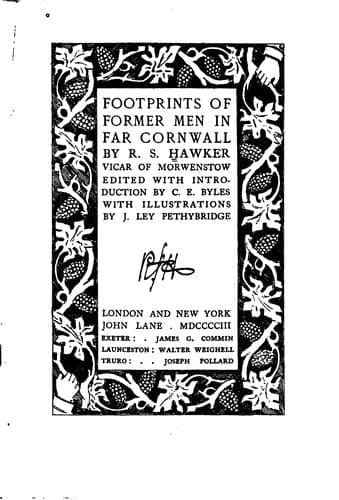
Footprints of Former Men in Far Cornwall — John Shaqi
Footprints of Former Men in Far CornwallHawker, Robert Stephen
History
Footprints of Former Men in Far Cornwall
Hawker, Robert Stephen
Cornwall (England : County) -- History
But Daniel’s principal ambition was to know and name the planets
and the stars. It was at the time when the discoveries of foreign
astronomers had peopled the heavens with fresh imagery, and our
own Newton had given to the ethereal phenomena of the sky a “local
habitation and a name.” It is very striking to discover when the minds
of any nation are flooded with new ideas and original trains of
thought, how soon the strange tidings will reach the very skirts of the
population, and borne, how we know not, will thrill the hamlet and the
village with the wonders that have roused and instructed the far-off
and civilised city. Thus even Daniel’s distant district became aware
of the novel science of the stars, and this intelligence failed not to
excite and foster the faculties of his original mind. Local legends
still record and identify the tall and craggy places where the youthful
“scholar” was wont to ascend and to rest all night with his face turned
upward to the sky, “learning the customs of the stars,” and “finding
out by the planets things to come.” Nor were his studies unassisted
and alone. A master-mind of those days, Cookworthy[70] of Plymouth, a
learned and scientific man, still famous in the west, found out and
fostered the genius of the intelligent youth. He gave him access to
his library, and allowed him to visit his orrery and other scientific
instruments; and the result of this kindness was shown in the tastes
and future peculiarities of the mind of Gumb. The stern necessities
of life demanded, in the course of time, that Daniel should fulfil
the destiny of his birth, and win his bread by the sweat of his brow;
for the meagre resources of his cottage-home had to be augmented by
his youthful labour. In the choice of an occupation his early habits
were not without their influence. He selected the craft of a hewer of
stone, a very common calling on the surrounding moors; and there he
toiled for several years of his succeeding life, amid the cyclopean
models of the early ages. The pillared rocks of that wild domain were
the monoliths of Celtic history, and the vast piles of the native moor
were the heaped and unhewn pyramids of an ancient and nameless people.
All these surrounding scenes acted on his tastes and impulses. “So
the foundations of his mind were laid!” His father died, and Daniel
became his own master, and had to hew his way through the rugged world
by what the Cornish call “the pith of his bones.” That he did so his
future history will attest; but it was not unsoothed nor alone; nor
was it without the usual incident of human existence. No man ever yet
became happily great or joyfully distinguished without that kindling
strength, the affectionate presence of a woman.
“He who Joy would win,
Must share it: Happiness was born a twin.”
Public-domain text, read in full here on John Shaqi.
Reviews
Reviews
No reviews yet
Be the first to share your thoughts on this work.
Join the Discussion
Join the discussion
Sign in to leave a comment or review.
Sign InorCreate an account