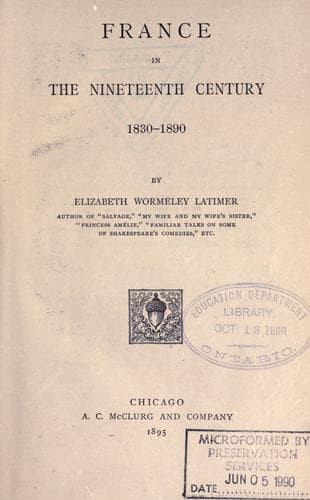
France in the Nineteenth CenturyLatimer, Elizabeth Wormeley
History
France in the Nineteenth Century
Latimer, Elizabeth Wormeley
France -- History -- 1789-1900
But though Louis Blanc is right in saying that the evil that Napoleon
did, lived after him in the memories of thinking men, it is also
true that those born since the fall of the Second Empire can have
no idea of the general enthusiasm that still lingered in France in
Louis Philippe's reign, round memories of the glories of Napoleon.
Men might not wish him back again, but they worshipped him as the
national demigod. After Sedan he was pulled down literally and
metaphorically from his pedestal; and the old feelings about him
which half a century ago even foreign nations seemed to share,
now seem obsolete and extravagant to readers of Lanfrey and the
books of Erckmann-Chatrian.
Even in 1836, when Louis Napoleon in secret entered Strasburg,
he was surprised and disappointed to find that those on whom he
had counted to assist him in making the important "first step" in
his career, were very doubtful of its prudence. He had counted on
the co-operation of General Voirol, an old soldier of the Empire who
was in command of the Department in which Strasburg was situated; but
when he wrote him a letter, in the most moving terms appealing to
his affection for the emperor, the old general not only declined to
join the plot, but warned the Prefect of Strasburg that mischief was
on foot, though he did not mention in what quarter. The Government
in Paris seems, however, to have concluded that it would be best to
let a plot so very rash come to a head. There was a public singer,
calling herself Madame Gordon, at Baden, who flung herself eagerly
into the conspiracy. Louis Napoleon on quitting Arenenberg had
expected to meet several generals of distinction, who had served
under his uncle, at a certain trysting-place between Arenenberg
and Strasburg. He waited for them three days, but they never came.
He then resolved to continue his campaign without their aid or
encouragement, and entered Strasburg secretly on the night of Oct.
28, 1836. The next morning he had an interview with Colonel Vambéry,
who endeavored to dissuade him from his enterprise.
Vambéry's prudent reasons made no impression on the prince, and
he then promised his assistance. Having done so, Louis Napoleon
offered him a paper, securing a pension of 10,000 francs to each
of his two children, in case he should be killed. The colonel tore
it up, saying, "I give, but do not sell, my blood." Major Parquin,
an old soldier of the Empire, who was in the garrison, had been
already won. On the night of the prince's arrival the conspirators
met at his lodging.
Public-domain text, read in full here on John Shaqi.
Reviews
Reviews
No reviews yet
Be the first to share your thoughts on this work.
Join the Discussion
Join the discussion
Sign in to leave a comment or review.
Sign InorCreate an account