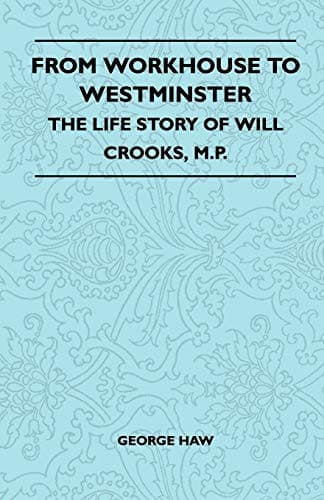
From Workhouse to Westminster: The Life Story of Will Crooks, M.P. — John Shaqi
From Workhouse to Westminster: The Life Story of Will Crooks, M.P.Haw, George
History
From Workhouse to Westminster: The Life Story of Will Crooks, M.P.
Haw, George
Crooks, William, 1852-1921; Legislators -- Great Britain -- Biography; Social reformers -- Great Britain -- Biography
When Crooks entered the London County Council in 1892 he was a stranger
to almost all outside the little circle of Labour men sent up from other
divisions.
As a pioneer in Labour representation in London he had more than the
usual amount of suspicion and opposition to surmount. In those days a
Labour representative was often subjected to fierce personal attacks
both from the class he represented and from the better-off classes whose
domains for the first time working-men were entering. His every word and
act were under a double microscope. He had to be a Spartan in endurance
and a saint in character.
"Imagine," he once said to me during his early days on the Council, at
the time when one of its members, a peer, was associated with a
notorious case in the High Court, "imagine what an outcry there would
have been up and down the land if that Councillor, instead of belonging
to the House of Lords, had been a Labour representative."
The Labour bench at the County Council set the standard for sound and
steady municipal administration to the Labour Party of the entire
country. John Burns sat at one end of the bench, Will Crooks at the
other. Between them sat, at different times, men like Will Steadman,
secretary of the Parliamentary Committee of the Trades Union Congress
and M.P. for Stepney and later for Central Finsbury; J. Ramsay
Macdonald, secretary of the Labour Party and M.P. for Leicester; Isaac
Mitchell, then secretary of the General Federation of Trade Unions; H.
R. Taylor, of the Bricklayers' Society, at one time Mayor of Camberwell;
C. W. Bowerman, of the London Society of Compositors and M.P. for
Deptford; George Dew, of the Carpenters' and Joiners' Society and
secretary of the Workmen's Cheap Trains Association; Harry Gosling, of
the Watermen's and Lightermen's Society; and W. Sanders, of the Fabian
Society and Independent Labour Party.
Crooks took the minutes of the first party meeting of the Labour Bench,
and he holds the document to this day. The meeting was held at the
offices of the Dockers' Union in the Mile End Road on April 26th, 1892,
a few weeks after the election which first made a L.C.C. Labour Party
possible. A line of policy was laid down that looks quite modest to-day,
now that it has become an integral part of ordinary L.C.C.
administration. At the time it was regarded by people outside the Labour
Movement as rank revolution.
Public-domain text, read in full here on John Shaqi.
Reviews
Reviews
No reviews yet
Be the first to share your thoughts on this work.
Join the Discussion
Join the discussion
Sign in to leave a comment or review.
Sign InorCreate an account