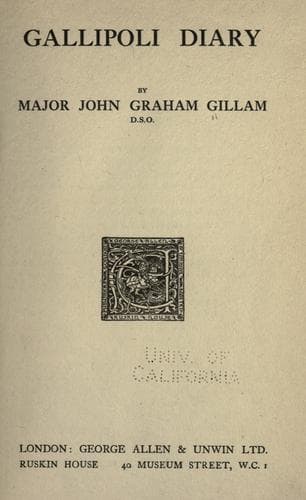
World War, 1914-1918 -- Campaigns -- Turkey -- Gallipoli Peninsula
Before breakfast this morning I am ordered to take two hundred
rations up to some Lancashire Fusiliers (Territorials) who have found
themselves in our part of the line. Arriving at Pink Farm, shrapnel
begins to come over, and I get the mules under cover of the farm as
best I can and go on to H.Q. I continue to walk along the road, and
then cut across the open country to the trench where the Brigade are.
They are sitting in the trench having breakfast, and tell me that the
Lancashire Fusiliers have now gone to the beach. Festin, of the Border
Regiment, is now our Brigade Major, and he asks me to take a message
to the Field Company of Engineers attached to the Brigade, just
behind Pink Farm, off the road. As we talk, shrapnel bursts over Pink
Farm and to its left, probably trying to get at a battery which is in
position there. I take my leave, and on getting back to Pink Farm I
find that one of the Syrian mule-drivers has been hit in the stomach by
a shrapnel bullet. He is lying on the ground behind the walls of the
farm groaning, and on seeing me cries piteously to me in Russian. I
send over to an Indian Field Ambulance close by, and in a few minutes
two native orderlies come running over noiselessly with a stretcher.
They stoop down, and with the tenderness of women lift the wounded boy
on to the stretcher and carry him away. We trek back, and on the way I
deliver the message to the Field Company.
For transport we now have little A.T. two-wheeled carts, known in
the Indian Army as ammunition transport, drawn by two little Indian
mules. These are in camp near the lighthouse, between “W” Beach and “V”
Beach. Delightful place this, and most interesting. The orderliness of
everything is astonishing; the quaint little tents—oblong, with sloping
sides—are arranged in neat rows. The inhabitants are surely the most
cleanly people on earth. Here I see groups of them, stripped except
for a loin-cloth, busy washing their shining, dusky bodies. After
this, little brass jars are produced, from which oil is poured over
them and rubbed in. Others, having finished this, are industriously
combing their long black locks and bushy beards. Others, again, are
making chupatty, a species of pancake, in broad, shallow metal bowls—I
taste one and find it excellent. Other groups of these dark warriors
are sitting outside their little tents smoking hookahs; all the men we
meet salute punctiliously. Near by are the white officers’ tents, quite
luxurious affairs. The whole place is delightful and looks almost like
a riverside picnic, only everything is very orderly. As to the carts
before mentioned, these are most ingenious. They are little two-wheeled
affairs with a pole, like the old-fashioned curricle; each is drawn by
two small mules, not larger than ponies. Wonderful little fellows they
are, bred in Northern India—Kashmere and Thibet, I believe. Lord! how
they work—they can pull almost anything, and they are so surefooted and
Public-domain text, read in full here on John Shaqi.
Reviews
Reviews
No reviews yet
Be the first to share your thoughts on this work.
Join the Discussion
Join the discussion
Sign in to leave a comment or review.
Sign InorCreate an account