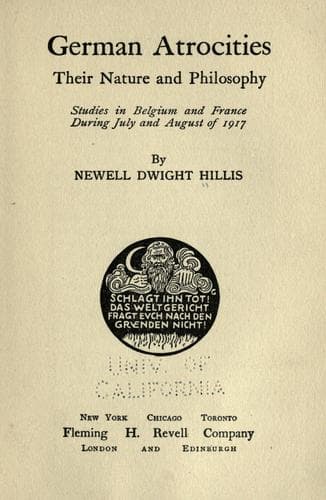
German Atrocities: Their Nature and PhilosophyHillis, Newell Dwight
History
German Atrocities: Their Nature and Philosophy
Hillis, Newell Dwight
Pangermanism; World War, 1914-1918; World War, 1914-1918 -- Atrocities
During the past forty years there have been in Germany on the one hand,
and in the Allied states on the other, two incompatible and mutually
destructive principles,--one named Military Autocracy and the other
Democracy. The conflict between the two was irrepressible, and our
entrance into the war inevitable. Lincoln once said that a house
divided against itself could not stand; that the republic could not
endure half slave and half free; that it must become all one thing
or all the other. To-day Europe, and indeed the world, represent a
house divided against itself. It cannot remain half autocratic and
half democratic; it must become all one thing or all the other. Either
Germany must conquer England, France and the United States, and impose
autocracy upon them, and enthrone the Kaiser as the world emperor,
or else the Allies must conquer Germany, and overthrow autocracy and
militarism, until Germany, and Austria, Bulgaria and Turkey become
truly self-governed. On that August day in 1914, therefore, it became
morally obligatory upon every patriot, every city and every nation to
make the choice between autocracy and democracy. In the hour when the
battle lines were set in array, between autocracy and democracy, on
August 4, 1914, neutrality became intellectually absurd and morally
monstrous. Serving both God and Mammon became unthinkable. Even after
our President declared that we must make the world safe for democracy,
a few men tried to be neutral, and stretched out the right hand to
Germany and the left hand to the United States, in the spirit of the
man who declined to choose between hell and heaven, saying he had
friends in both places. The time has fully come to recognize that
civilization and autocracy are deadly antagonists. John Milton defined
a book as the precious life-blood of a master spirit, treasured up
and handed on to the future. "As good almost kill a man as kill a
good book." But the free and democratic institutions are the precious
life-blood of the patriots, the heroes and martyrs, preserved,
and handed forward, as means for winning the Golden Age. Better,
therefore, a thousand times, that the Kaiser should murder mankind than
assassinate the free institutions that manufacture manhood of good
quality, and make human life worth the living.
THE STRENGTH OF OUR ENEMY
Public-domain text, read in full here on John Shaqi.
Reviews
Reviews
No reviews yet
Be the first to share your thoughts on this work.
Join the Discussion
Join the discussion
Sign in to leave a comment or review.
Sign InorCreate an account