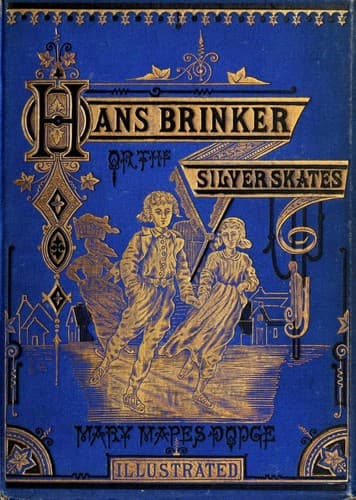
Hans Brinker; Or, The Silver SkatesDodge, Mary Mapes
History
Hans Brinker; Or, The Silver Skates
Dodge, Mary Mapes
Netherlands -- History -- 19th century -- Juvenile fiction; Siblings -- Juvenile fiction; Skating -- Juvenile fiction
Even Gretel had seen them flitting before her as she sat beside her
mother through those hours of weary watching--not as prizes to be won,
but as treasures passing hopelessly beyond her reach.
Rychie, Hilda and Katrinka--why they had scarcely known any other
thought than "the race! the race! It will come off on the Twentieth!"
These three girls were friends. Though of nearly the same age, talent
and station, they were as different as girls could be.
Hilda van Gleck you already know, a warm-hearted, noble girl of
fourteen. Rychie Korbes was beautiful to look upon, far more sparkling
and pretty than Hilda, but not half so bright and sunny within. Clouds
of pride, of discontent and envy had already gathered in her heart, and
were growing bigger and darker every day. Of course these often relieved
themselves very much after the manner of other clouds--But who saw the
storms and the weeping? Only her maid, or her father, mother and little
brother--those who loved her better than all. Like other clouds, too,
hers often took queer shapes, and what was really but mist and vapory
fancy, assumed the appearance of monster wrongs, and mountains of
difficulty. To her mind, the poor peasant-girl Gretel was not a human
being, a God-created creature like herself--she was only something that
meant poverty, rags and dirt. Such as Gretel had no right to feel, to
hope; above all, they should never cross the paths of their
betters--that is, not in a disagreeable way. They could toil and labor
for them at a respectful distance, even admire them, if they would do it
humbly, but nothing more. If they rebel, put them down--If they suffer,
don't trouble me about it, was Rychie's secret motto. And yet how witty
she was, how tastefully she dressed, how charmingly she sang; how much
feeling she displayed (for pet kittens and rabbits), and how completely
she could bewitch sensible, honest-minded lads like Lambert van Mounen
and Ludwig van Holp!
Carl was too much like her, within, to be an earnest admirer, and
perhaps he suspected the clouds. He, being deep and surly, and always
uncomfortably in earnest, of course preferred the lively Katrinka, whose
nature was made of a hundred tinkling bells. She was a coquette in her
infancy, a coquette in her childhood, and now a coquette in her
school-days. Without a thought of harm, she coquetted with her studies,
her duties, even her little troubles. They shouldn't know when they
bothered her, not they. She coquetted with her mother, her pet lamb, her
baby brother, even with her own golden curls--tossing them back as if
she despised them. Every one liked her, but who could love her? She was
never in earnest. A pleasant face, a pleasant heart, a pleasant
manner--these only satisfy for an hour. Poor, happy Katrinka! such as
she, tinkle, tinkle so merrily through their early days; but Life is so
apt to coquette with them in turn, to put all their sweet bells out of
tune, or to silence them one by one!
Public-domain text, read in full here on John Shaqi.
Reviews
Reviews
No reviews yet
Be the first to share your thoughts on this work.
Join the Discussion
Join the discussion
Sign in to leave a comment or review.
Sign InorCreate an account