Health Through Will PowerWalsh, James J. (James Joseph)
Science
Health Through Will Power
Walsh, James J. (James Joseph)
Mental healing; Mental health; Will
Here is the defect in systems which promise to help people to train
their wills by talking much about it, and by persuading them that it
can be done, that all they have to do is to set about it. Unless one
has some fine satisfying purpose in doing things, their doing is
difficult and fails to accomplish as much good for the doer as would
otherwise be the case. Conscious will activity requires, to use
old-fashioned psychological terms, the exercise of two faculties at
the same time, the consciousness and the will. This adds to the
difficulty of willing. What is needed is a bait of interest held up
before the will, constantly tempting it to further effort but without
any continuing consciousness on the part of the individual that he
must will it and keep on willing it. That must ever be a hampering
factor in the case. Human nature does not like imperatives and writhes
and wastes energy under them. On the contrary, optatives are pleasant
and give encouragement without producing a contrary reaction; and it
is this state of mind and will that is by far the best for the
individual.
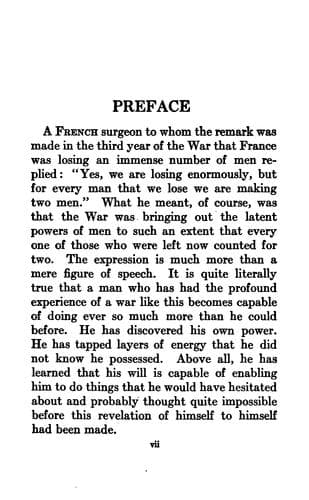
Above all, it is important that the person forming new habits should
feel that there is nothing else to be done except the hard things
{100} that have been outlined. If there is any mode of escape from the
fulfillment of hard tasks, human nature will surely find it. If our
young soldiers had felt that they did not have to perform their
military duties and that there was some way to avoid them, the taking
of the training would have proved extremely difficult. They just _had_
to take it; there was no way out, so they pushed themselves through
the difficulties and then after a time they found that they were
tapping unsuspected sources of energy in themselves. For when people
_have_ to do things, they find that they can do ever so much more than
they thought they could, and in the doing, instead of exhausting
themselves, they actually find it easier to accomplish more and more
with ever less difficulty. The will must by habit be made so prompt to
obey that obedience will anticipate thought in the matter and
sometimes contravene what reason would dictate if it had a chance to
act. The humorous story of the soldier who, carrying his dinner on a
plate preparatory to eating it, was greeted by a wag with the word
"Attention!" in martial tones, and dropped his dinner to assume the
accustomed attitude, is well known. Similar practical jokes are said
to have been played, on a certain number {101} of occasions in this
war, with the thoroughly trained young soldier.
Public-domain text, read in full here on John Shaqi.
Reviews
Reviews
No reviews yet
Be the first to share your thoughts on this work.
Join the Discussion
Join the discussion
Sign in to leave a comment or review.
Sign InorCreate an account