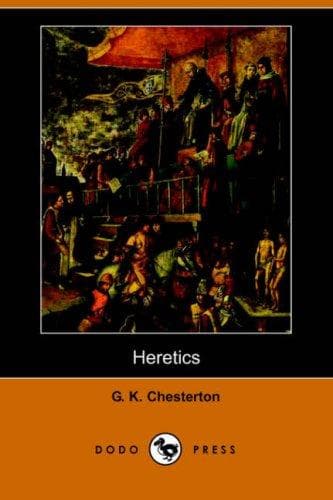
Apologetics; Chesterton, G. K. (Gilbert Keith), 1874-1936
It is necessary to dwell on this defect in Mr. Moore, because it is
really the weakness of work which is not without its strength. Mr.
Moore’s egoism is not merely a moral weakness, it is a very constant
and influential aesthetic weakness as well. We should really be much
more interested in Mr. Moore if he were not quite so interested in
himself. We feel as if we were being shown through a gallery of really
fine pictures, into each of which, by some useless and discordant
convention, the artist had represented the same figure in the same
attitude. “The Grand Canal with a distant view of Mr. Moore,” “Effect
of Mr. Moore through a Scotch Mist,” “Mr. Moore by Firelight,” “Ruins
of Mr. Moore by Moonlight,” and so on, seems to be the endless series.
He would no doubt reply that in such a book as this he intended to
reveal himself. But the answer is that in such a book as this he does
not succeed. One of the thousand objections to the sin of pride lies
precisely in this, that self-consciousness of necessity destroys
self-revelation. A man who thinks a great deal about himself will try
to be many-sided, attempt a theatrical excellence at all points, will
try to be an encyclopaedia of culture, and his own real personality
will be lost in that false universalism. Thinking about himself will
lead to trying to be the universe; trying to be the universe will lead
to ceasing to be anything. If, on the other hand, a man is sensible
enough to think only about the universe; he will think about it in his
own individual way. He will keep virgin the secret of God; he will see
the grass as no other man can see it, and look at a sun that no man has
ever known. This fact is very practically brought out in Mr. Moore’s
“Confessions.” In reading them we do not feel the presence of a
clean-cut personality like that of Thackeray and Matthew Arnold. We
only read a number of quite clever and largely conflicting opinions
which might be uttered by any clever person, but which we are called
upon to admire specifically, because they are uttered by Mr. Moore. He
is the only thread that connects Catholicism and Protestantism, realism
and mysticism—he or rather his name. He is profoundly absorbed even
in views he no longer holds, and he expects us to be. And he intrudes
the capital “I” even where it need not be intruded—even where it
weakens the force of a plain statement. Where another man would say,
“It is a fine day,” Mr. Moore says, “Seen through my temperament, the
day appeared fine.” Where another man would say “Milton has obviously a
fine style,” Mr. Moore would say, “As a stylist Milton had always
impressed me.” The Nemesis of this self-centred spirit is that of being
totally ineffectual. Mr. Moore has started many interesting crusades,
but he has abandoned them before his disciples could begin. Even when
he is on the side of the truth he is as fickle as the children of
falsehood. Even when he has found reality he cannot find rest. One
Public-domain text, read in full here on John Shaqi.
Reviews
Reviews
No reviews yet
Be the first to share your thoughts on this work.
Join the Discussion
Join the discussion
Sign in to leave a comment or review.
Sign InorCreate an account