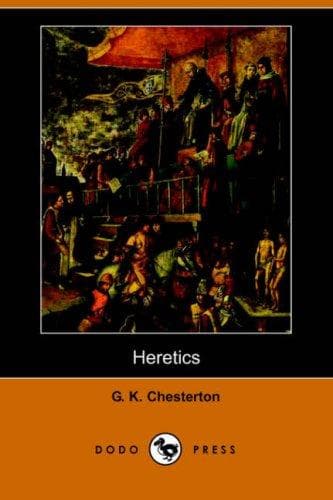
Apologetics; Chesterton, G. K. (Gilbert Keith), 1874-1936
They would be improved by high living and plain thinking. A
little high living (I say, having a full sense of responsibility, a
little high living) would teach them the force and meaning of the human
festivities, of the banquet that has gone on from the beginning of the
world. It would teach them the historic fact that the artificial is,
if anything, older than the natural. It would teach them that the
loving-cup is as old as any hunger. It would teach them that ritualism
is older than any religion. And a little plain thinking would teach
them how harsh and fanciful are the mass of their own ethics, how very
civilized and very complicated must be the brain of the Tolstoyan who
really believes it to be evil to love one’s country and wicked to
strike a blow.
A man approaches, wearing sandals and simple raiment, a raw tomato held
firmly in his right hand, and says, “The affections of family and
country alike are hindrances to the fuller development of human love;”
but the plain thinker will only answer him, with a wonder not untinged
with admiration, “What a great deal of trouble you must have taken in
order to feel like that.” High living will reject the tomato. Plain
thinking will equally decisively reject the idea of the invariable
sinfulness of war. High living will convince us that nothing is more
materialistic than to despise a pleasure as purely material. And plain
thinking will convince us that nothing is more materialistic than to
reserve our horror chiefly for material wounds.
The only simplicity that matters is the simplicity of the heart. If
that be gone, it can be brought back by no turnips or cellular
clothing; but only by tears and terror and the fires that are not
quenched. If that remain, it matters very little if a few Early
Victorian armchairs remain along with it. Let us put a complex entree
into a simple old gentleman; let us not put a simple entree into a
complex old gentleman. So long as human society will leave my
spiritual inside alone, I will allow it, with a comparative submission,
to work its wild will with my physical interior. I will submit to
cigars. I will meekly embrace a bottle of Burgundy. I will humble
myself to a hansom cab. If only by this means I may preserve to myself
the virginity of the spirit, which enjoys with astonishment and fear. I
do not say that these are the only methods of preserving it. I incline
to the belief that there are others. But I will have nothing to do
with simplicity which lacks the fear, the astonishment, and the joy
alike. I will have nothing to do with the devilish vision of a child
who is too simple to like toys.
Public-domain text, read in full here on John Shaqi.
Reviews
Reviews
No reviews yet
Be the first to share your thoughts on this work.
Join the Discussion
Join the discussion
Sign in to leave a comment or review.
Sign InorCreate an account