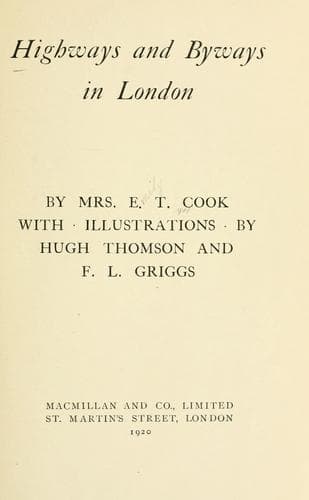
Highways and Byways in LondonCook, Emily Constance Baird
History
Highways and Byways in London
Cook, Emily Constance Baird
London (England) -- Description and travel
Returning home, Rahere gained the king's
consent to the work, which was forthwith begun, and assisted greatly
by miraculous agency; such as bright light shining on the roof of the
rising edifice, wonderful cures worked there, and all such
supernatural revelations. When Rahere died, in the odour of sanctity,
and the first prior of his foundation, he left thirteen canons
attached to it; which number his successor, Prior Thomas, had raised
in 1174 to thirty-five. Thus the monastery grew through successive
priors, till it was one of the largest religious houses in London. Its
precincts and accessories extended at one time as far as Aldersgate
Street; these however vanished with the dissolution of the monasteries
by Henry VIII., and all that remains to the present day is the
abbreviated priory church and a small part of a cloister. In monastic
times the nave of the edifice extended, indeed, the whole length of
the little churchyard, as far as the dog-toothed Smithfield entrance
gate; but of the ancient church nothing now remains intact but the
choir, with the first bay of the nave and portions of the transepts.
Yet the recent restorations have been most successfully carried out,
and the first view of the interior is striking in its grand old Norman
simplicity. The choir has a triforium and a clerestory, and
terminates in an apse, pierced by curious horseshoe arches; behind
runs a circulating ambulatory dividing it from the adjoining "Lady
chapel." Worthy of notice is the finely-wrought modern iron screen,
the work of Mr. Starkie Gardner, that separates this chapel from the
apse. The church has been altered, added to, or mutilated, from time
to time; and other styles of architecture, such as Perpendicular, have
occasionally been introduced; but yet the main effect of the interior
is Norman. The beautiful Norman apse, built over and obliterated in
the 15th century, has, by the talent of Mr. Aston Webb, been now
restored to its original design. Indeed, the whole edifice has in
recent times and by the efforts of late rectors and patrons, been
extricated from dirt, lumber and decay; the work of restoration
beginning in 1864. The restorer has done his work most faithfully,
preserving all the old walls, and utilising the old Norman stones used
in previous re-buildings.
Public-domain text, read in full here on John Shaqi.
Reviews
Reviews
No reviews yet
Be the first to share your thoughts on this work.
Join the Discussion
Join the discussion
Sign in to leave a comment or review.
Sign InorCreate an account