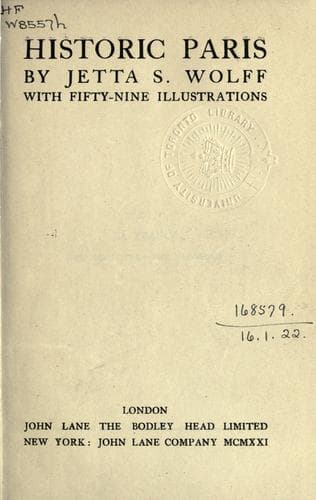
Paris (France) -- Description and travel; Paris (France) -- History
Simon-le-Franc is one of the oldest among all these old streets, for it
was a thoroughfare in the year 1200. It records the name of a worthy
citizen of his day, one Simon Franque. All the houses are ancient, some
very picturesque. Next in date is that most characteristic of old-time
streets, the Rue de Venise. The name, a misnomer, dates only from 1851,
due to an old sign. The street was known by various appellations since
its formation somewhere about the year 1250. Every house and court there
is ancient, the space between those on either side so narrow that the
tall, dark buildings seem to meet at their apex. No. 27 is the old inn
“l’Épée de Bois,” lately renovated and its name changed to “L’Arrivée de
Venise,” where from the year 1658 a company of musicians and
dancing-masters duly licensed by Mazarin used to meet under the
direction of “Le roi des violons,” their chief. This was, in fact, the
nucleus of the Académie National of Music and Dancing, known later as
the Conservatoire. Great men of letters too were wont to meet in that
old inn. Rue de Venise opens into Rue Beaubourg, a road that stretched
through a _beau bourg_, i.e. a fine township, so far back as the
eleventh century, with special privileges, the rights of citizenship for
its inhabitants although lying without the boundary-wall. No. 4, now
razed, was the “Restaurant du Bon Bourg,” _tenu par_ “le Roi du Bon
Vin.” To the left is Rue des Étuves, i.e. Bath Street, with houses old
and curious. Rue de Venise runs at its lower end into the famous Rue de
Quincampoix, the street of Law’s bank (_see_ p. 63), where every house
is ancient or has vestiges of past ages. No. 43 was a shop let in Law’s
time at the rate of 100 francs a day. The street leads down into Rue des
Lombards, the ancient usurers’ and pawnbrokers’ street, inhabited in
these days by a very opposite class--herborists. Tradition says
Boccaccio was born here. Rue du Temple, Rue des Archives, Rue
Vieille-du-Temple, Rue de Sévigné, traversed in part in the 3rd
arrondissement (_see_ p. 108) all have their lower numbers in this 4th
arrondissement, the first three branching off from Rue de Rivoli, the
last from Rue St-Antoine. At No. 61, Rue du Temple, on the site of the
vanished Couvent des Filles de Ste-Avoie, we see an old gabled house. In
the courtyard of No. 57, l’hôtel de Titon, the Bastille armourer. At No.
41 the old tavern “l’Aigle d’Or.” No. 20 is the ancient office of the
Gabelles--the salt-tax. Here we see an old sign taken from the vicinity
of St-Gervais, showing the famous elm-tree, of which more anon. Every
house shows some interesting old-time feature. This brings us again
close up to the Hôtel de Ville, where we see the venerable church
St-Gervais-et-St-Protais, dating in its present form from the sixteenth
century, on the site of a church built there in the sixth. That
primitive erection grew into a beautiful church in the early years of
the twelfth century. Some of the exquisite work of that day may still be
Public-domain text, read in full here on John Shaqi.
Reviews
Reviews
No reviews yet
Be the first to share your thoughts on this work.
Join the Discussion
Join the discussion
Sign in to leave a comment or review.
Sign InorCreate an account