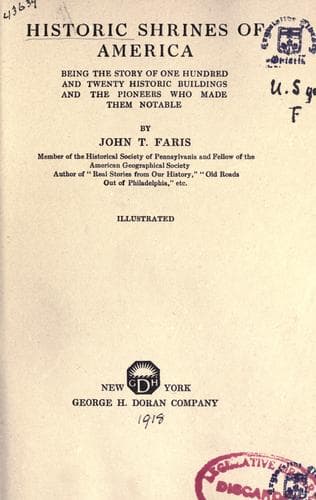
Historic Shrines of America: Being the Story of One Hundred and Twenty Historic Buildings and the Pioneers Who Made Them NotableFaris, John T. (John Thomson)
History
Historic Shrines of America: Being the Story of One Hundred and Twenty Historic Buildings and the Pioneers Who Made Them Notable
Faris, John T. (John Thomson)
Historic buildings -- United States; United States -- Biography
Marblehead was a comparatively insignificant port when Jeremiah Lee
came to town. At once he made a place for himself among the humble
fishermen and other seafaring men of the place. He was a member of the
Board of Firewards in the town's first fire department, and he served
on important committees.
When, in 1768, he built a wonderful mansion that cost more than ten
thousand pounds, the most wonderful house in Massachusetts at the
time, his townsmen knew him well enough to understand that he was
their good friend, even if he did have much more money than any of
them.
The Lee Mansion was a hospitable home. The Colonel and his wife Martha
entertained lavishly, not only the people of the town but famous men
from abroad. In 1789 Washington was entertained in the house. But it
was one of the glories of the mansion that the humblest mariner in the
place was not slow to go there if he wished to have a chat with the
bluff owner or if he desired to go to the quaint cupola from which it
is possible to look far out to sea. To this outlook Colonel Lee
himself often went, for his ships were sailing to Marblehead from all
parts of the world, and he was as eager as any one to turn his eyes
seaward.
The house is sixty-four feet by forty-six feet, and the walls are of
brick, though they are covered with wooden clapboards two feet by one
and a half feet. There are fifteen rooms, in addition to the great
halls that make the house seem like a palace.
In these rooms the Colonel conferred with other patriots as to the
welfare of Massachusetts and all the colonies. From the house he went
out to the town meetings where the men gathered to talk over the
Boston Port Bill and the Boston Tea Party and questions of Taxation
without Representation.
He rejoiced to serve as a representative in the General Court and on
the Committee of Safety and Supplies of the Province. He was chosen to
represent the town in the Continental Congress, and when he was unable
to go, Elbridge Gerry, who later became Vice-President of the United
States, was sent in his place at the expense of the town.
On the night of April 18, 1775, in company with Elbridge Gerry and
Azor Orin, who were members with him of the Committee of Safety and
Supplies, he was attending a meeting at Weatherby's Black Horse Tavern
just outside of Cambridge. The meeting adjourned so late that the
three men decided to spend the night at the tavern. The eight hundred
British soldiers who were on their way that night to Lexington learned
of the presence in Cambridge of the patriots. Some one rushed to the
tavern and roused them from slumber. They did not even have time to
put on their clothes, but ran at once from the house and hid
themselves at some distance from the tavern. When the disappointed
troops had gone on, the hunted men returned to their room.
Public-domain text, read in full here on John Shaqi.
Reviews
Reviews
No reviews yet
Be the first to share your thoughts on this work.
Join the Discussion
Join the discussion
Sign in to leave a comment or review.
Sign InorCreate an account