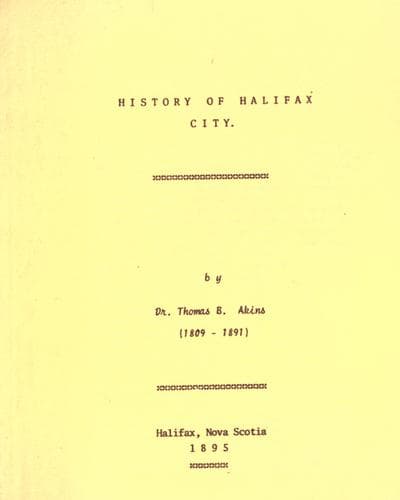
On 30th June, 1757, Lord Loudon with his transports and 12,000 regulars
and provincials arrived at Halifax, and on July following, Admiral
Holborn arrived with his fleet. This armament, which was destined for an
attack on Louisburg, left Halifax early in August, but having proved a
failure the fleet returned to England in September, but Loudon returned
with his army to New York; they both left Halifax on the same day, 16th
August. Holborn arrived at Louisburg on 20th, where finding the French
fleet superior to his own, he continued to cruise off Louisburg harbour
until 24th September, when he encountered a severe gale of wind which
scattered his fleet, several ships were lost, eight sail got safe to
Portsmouth, and the rest got to New York. This powerful armament
consisted of 13 sail of the line--the Newark 80 guns, Invincible 74,
Grafton 68, Terrible 74, Northumberland 68, Captain 68, Bedford 64,
Orford 68, Nassau 64, Sunderland 64, Defiance 64, Tilbury 64, Kingston
60, Windsor 54, and the Sutherland 50, with several others which
afterwards joined them, and 16 smaller vessels of war. The naval forces
amounted 10,000 men, and the land forces to 12,000, six thousand of whom
were provincial troops. Loudon left three regiments at Halifax, and
several of the vessels remained to winter here.
In May of this year the Governor and Council offered a bounty for sowing
land with grass on the peninsula of Halifax, also for the erection of
stone fences around the lots, and for raising grain and potatoes.
Loudon was succeeded in the supreme command by Abercrombie, another
incompetent--a debilitated old man who remained in command for a short
time. He was succeeded by Sir Jeffrey Amherst.
In the following spring about 12,000 troops arrived at Halifax, under
the command of General Amherst. They were soon followed by Admiral
Boscawen from England with a large fleet consisting of 23 ships of the
line and 18 frigates. This great fleet arrived in Halifax harbour in
May, 1758, accompanied by 120 transports. The land forces amounted to
12,260 men. On Sunday, 28th May, they set sail from Halifax, 157 vessels
in all. They were met by General Amherst, with part of the force, as
they went out of the harbour. Governor Lawrence accompanied the army and
took command of one of the Brigades, Colonel Monkton being left in
command during his absence.
After the siege, which was protracted for two months, part of the fleet
and army returned to Halifax, and some of the vessels remained to refit.
The colony was sacked for provisions and the town turned into a camp for
the troops. A number of the provincial soldiers and others, having
enriched themselves with the spoils at Louisburg, became settlers in the
town. All the ammunition and stores, with a quantity of private
property, were removed to Halifax, and the town once again began to
assume a prosperous appearance.
Public-domain text, read in full here on John Shaqi.
Reviews
Reviews
No reviews yet
Be the first to share your thoughts on this work.
Join the Discussion
Join the discussion
Sign in to leave a comment or review.
Sign InorCreate an account