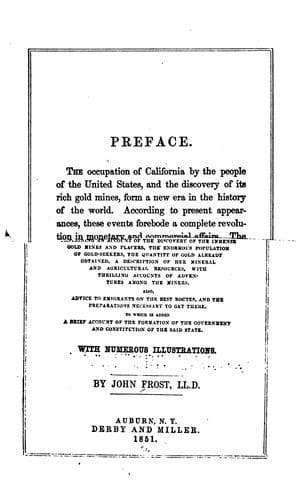
History of the State of California: From the Period of the Conquest by Spain to Her Occupation by the United States of AmericaFrost, John
History
History of the State of California: From the Period of the Conquest by Spain to Her Occupation by the United States of America
Frost, John
California -- Gold discoveries; California -- History
"I am satisfied that much of the crime and lawlessness that is
prevalent in California--particularly in towns like San Francisco,
where the ruder sex are congregated exclusively and in large
multitudes--is attributable to the want of the humanizing presence of
women. In San Francisco there were about ten thousand males, and
scarcely a hundred females; for, although in many parts of California
the latter outnumber the former, the national prejudice against color
was too strong for legitimate amalgamation to take place."
Such was San Francisco soon after the discovery of the riches of the
Sacramento region. From an insignificant settlement, sometimes the
resort of whaling-vessels, and of a few traders, it was quickly
transferred into a city, with an extensive and constantly increasing
commerce. In its streets and squares, erected where, just before, was
a desert plain, people of almost every nation were seen busily engaged
in traffic, or preparing for departure to the gold region. It seemed
the work of the enchanter.
Although, like San Francisco, _Monterey_ was almost deserted by its
inhabitants upon the receipt of information of the gold discovery, it
soon began to give signs of improvement. The bay, upon the shore of
which the town is located, is more exposed to the swell of the sea,
and to the north-west storms, than the Bay of San Francisco, and
therefore the harbor is inferior. Yet Monterey received a considerable
share of the tide of emigration. Those who stopped there were
generally persons who intended to make a permanent settlement, and
engage in mercantile pursuits; and, therefore, though the increase of
the town was not so rapid as that of San Francisco, it carried with it
more denotements of stability.
The town is situated on a short bend near the entrance of the bay,
upon its southern side. The point of land which partly protects its
harbor from the sea is called Point Pinos. A very neat and pretty
appearance is presented by the houses of the native Californians,
which are generally constructed of _adobés_ and white-plastered. Those
of the Americans are easily distinguished by their being built of logs
and planks, and presenting a more substantial, but rougher appearance.
The town is surrounded by hills, covered with lofty pine trees. Upon a
height which overlooks the town and harbor, a fort was built by the
Americans during the war with Mexico, and a military force continued
there till after the treaty of peace.
Public-domain text, read in full here on John Shaqi.
Reviews
Reviews
No reviews yet
Be the first to share your thoughts on this work.
Join the Discussion
Join the discussion
Sign in to leave a comment or review.
Sign InorCreate an account