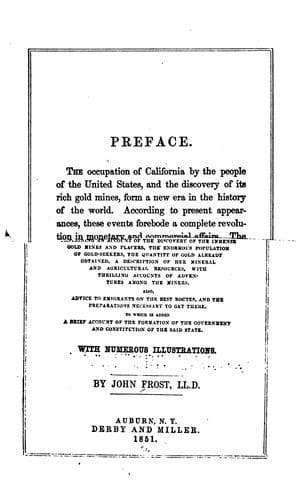
History of the State of California: From the Period of the Conquest by Spain to Her Occupation by the United States of AmericaFrost, John
History
History of the State of California: From the Period of the Conquest by Spain to Her Occupation by the United States of America
Frost, John
California -- Gold discoveries; California -- History
The progress of the town was not much affected by the gold mania. But
though it offers no attractions for mercantile or gold digging
purposes, it has others which will, no doubt, make it a favorite place
of residence. In 1849, it contained about one hundred and fifty
houses, built of _adobés_, and all one story in height. The town is
celebrated for being the residence of the aristocracy of California,
and for its beautiful women. Its inhabitants are principally
_rancheros_, who visit their _ranches_ two or three times in a year to
see to the marking and killing of their cattle, and then spend the
remainder of the year in the town, enjoying life as much as possible.
Indolence is the general vice. A horse to ride, plenty to eat, and
_cigaros_ to smoke constitute their _summum bonum_. Santa Barbara is
more celebrated for its fandangos than any other town on the coast.
These are open to all comers, and constitute the general pastime of an
evening. The climate is mild and spring-like, and, independent of the
attractions in the town, the surrounding country offers many of the
most beautiful rides in California. About a mile in the rear of the
town, at the top of a gentle slope, is the mission of Santa Barbara,
with its old, white walls and cross-mounted spires. The presiding
priest of California resides there, and a number of the converted
Indians still remain and cultivate the surrounding soil. The mission
is in a better condition than any other in the country.
_Ciudad de los Angeles_, or the City of the Angels, is situated a
hundred and ten miles south of Santa Barbara, at the end of an immense
plain, extending from the city twenty-five miles, to San Pedro, its
port. This is the garden spot of California. Before the discovery of
the gold mines, the City of the Angels was the largest town in the
country. It contains about two thousand inhabitants, most of whom are
wealthy _rancheros_, who dwell there to cultivate the grape. As in all
the towns of California, the houses are constructed of _adobé_ and
covered with asphaltum, which is found in great quantities near the
town. The northern section is laid out in streets, and is occupied by
the trading citizens; the southern section is made up of gardens,
vinyards and orchards, which are made extremely productive by
irrigating the soil with the water of a large stream running through
them. Many acres of ground are covered with vines, which, being
trimmed every year, are kept about six feet in height. In the fall of
the year, these vines are burdened with rich clusters of grapes; and,
in addition to these, great quantities of fruit of various kinds are
raised. The surrounding country abounds with game of all kinds. In the
rainy season, millions of ducks and geese cover the plains between Los
Angeles and San Pedro, while the neighboring hills abound with quails,
deer, elk, and antelope. The vineyards produce such quantities of
grapes, that many thousand barrels of wine and _aguardiente_--the
Public-domain text, read in full here on John Shaqi.
Reviews
Reviews
No reviews yet
Be the first to share your thoughts on this work.
Join the Discussion
Join the discussion
Sign in to leave a comment or review.
Sign InorCreate an account