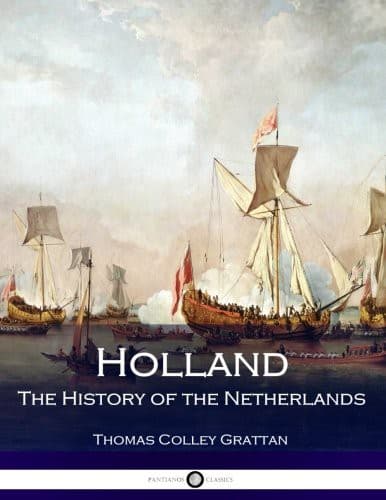
Holland: The History of the Netherlands — John Shaqi
Holland: The History of the NetherlandsGrattan, Thomas Colley
History
Holland: The History of the Netherlands
Grattan, Thomas Colley
Netherlands -- History
As the partial independence of the great vassals became consolidated,
the monarchs were proportionally anxious to prevent its perpetuation
in the same families. In pursuance of this system, Godfrey of Eenham
obtained the preference over the Counts Lambert and Robert; and
Frederick of Luxemburg was named duke of Lower Lorraine in 1046,
instead of a second Godfrey, who was nephew and expectant heir to
the first. But this Godfrey, upheld by Baldwin of Flanders, forced
the emperor to concede to him the inheritance of the dukedom.
Baldwin secured for his share the country of Alost and Waas, and the
citadel of Ghent; and he also succeeded in obtaining in marriage
for his son the Countess Richilde, heiress of Hainault and Namur.
Thus was Flanders incessantly gaining new aggrandizement, while
the duchy of Lorraine was crumbling away on every side.
In the year 1066 this state of Flanders, even then flourishing
and powerful, furnished assistance, both in men and ships, to
William the Bastard of Normandy, for the conquest of England.
William was son-in-law to Count Baldwin, and recompensed the
assistance of his wife's father by an annual payment of three
hundred silver marks. It was Mathilda, the Flemish princess and
wife of the conqueror, who worked with her own hands the celebrated
tapestry of Bayeux, on which is embroidered the whole history
of the conquest, and which is the most curious monument of the
state of the arts in that age.
Flanders acquired a positive and considerable superiority over all
the other parts of the Netherlands, from the first establishment
of its counts or earls. The descendants of Baldwin Bras-de-fer,
after having valiantly repulsed the Normans toward the end of
the ninth century, showed themselves worthy of ruling over an
industrious and energetic people. They had built towns, cut down
and cleared away forests, and reclaimed inundated lands: above
all things, they had understood and guarded against the danger
of parcelling out their states at every succeeding generation;
and the county of Flanders passed entire into the hands of the
first-born of the family. The stability produced by this state
of things had allowed the people to prosper. The Normans now
visited the coasts, not as enemies, but as merchants; and Bruges
became the mart of the booty acquired by these bold pirates in
England and on the high seas. The fisheries had begun to acquire
an importance sufficient to establish the herring as one of the
chief aliments of the population. Maritime commerce had made such
strides that Spain and Portugal were well known to both sailors
and traders, and the voyage from Flanders to Lisbon was estimated
at fifteen days' sail. Woollen stuffs formed the principal wealth
of the country; but salt, corn, and jewelry were also important
branches of traffic; while the youth of Flanders were so famous for
their excellence in all martial pursuits that foreign sovereigns
were at all times desirous of obtaining bodies of troops from
Public-domain text, read in full here on John Shaqi.
Reviews
Reviews
No reviews yet
Be the first to share your thoughts on this work.
Join the Discussion
Join the discussion
Sign in to leave a comment or review.
Sign InorCreate an account