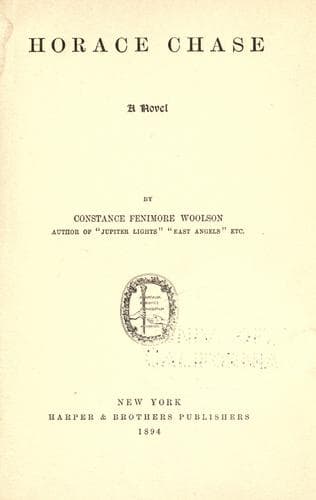
Didactic fiction; Men -- United States -- Fiction; United States -- Social life and customs -- 19th century -- Fiction
"The ladies I have mentioned think that his originality is his strongest
point," objected Dolly. "He produces great effects by describing some
one in this way, for instance: 'He had small eyes and a grin. He was
remarkably handsome.' This leaves them open-mouthed. But Miss Billy
herself, as she stands, is his greatest effect; she was never outlined
in very vivid hues, and now she has so effaced herself, rubbed herself
out, as it were (from fear lest he should call her 'sensational'), that
she is like a skeleton leaf. She has the greatest desire to be
'delicate,' extremely delicate, in everything that she does; and she
tries to sing, therefore, with so much expression that it's all
expression and very little singing! 'Coarse!'--that is to her the most
terrible word in the whole vocabulary. I asked her once whether her
horned tryceratops, with his seventy-five feet of length, might not have
been a little coarse in his manners."
"I declare I'll never go to see the woman again; she _is_ such a goose!"
exclaimed Etheridge, angrily.
Jared laughed. And then his mother laughed also, happy to see him
amused. But at the same time she was thinking: "You may not go to see
Billy. But, dear me! you will come to see _us_ forever and forever!" And
she had a weary vision of Etheridge, entering with his "hum-ha," and his
air of youth, five or six times a week as long as she lived.
"Commodore," said Dolly, "you may not go to see Miss Breeze. But I am
sure you will come to see _us_, with your cheerful hum-ha, and your
youthful face, as long as we live."
Mrs. Franklin passed her hand over her forehead. "There it is again!"
she thought. For, strangely often, Dolly would give voice to the very
ideas that were passing through her mother's mind at the moment. At
L'Hommedieu the two would fall into silence sometimes, and remain
silent for a half-hour, one with her embroidery, the other with her
knitting. And then when Dolly spoke at last, it would be of the exact
subject which was in her mother's mind. Mrs. Franklin no longer
exclaimed: "How could you know I was thinking of that!" It happened too
often. She herself never divined Dolly's thoughts. It was Dolly who
divined hers, most of the time unconsciously.
Meanwhile Etheridge had replied, in a reassuring voice: "Well, Dolly,
I'll do my best; you may count upon _that_." And then Ruth, leaning her
head against her brother's arm so that her face was hidden, laughed
silently.
Public-domain text, read in full here on John Shaqi.
Reviews
Reviews
No reviews yet
Be the first to share your thoughts on this work.
Join the Discussion
Join the discussion
Sign in to leave a comment or review.
Sign InorCreate an account