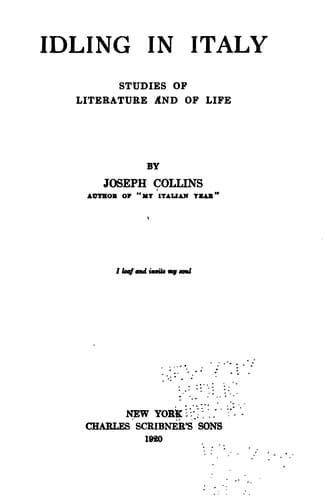
Idling in Italy: Studies of literature and of lifeCollins, Joseph
History
Idling in Italy: Studies of literature and of life
Collins, Joseph
Italian literature -- History and criticism
The hero, an artist, who would reform many customs of the land, went
about the countryside accompanied by two aids, one chosen for physical
strength, the other for his "promoter" type of mind. Their encounters
with the predatory innkeeper, with the peculating clerk, with the
industrious stone-breaker of the roads, with the pilferer of the farm or
the barn, and with the pulchritudinous peasant sitting picturesquely in
her cart or gossiping in the village constitute the substance of the
book. It was planned to have it run into several volumes, but it stopped
after the first one, without accomplishing any of the reforms that the
hero had essayed.
Then the writer reverted to art again and published a book on Cubism and
one on Cubism and Futurism. Soon he published Giornale di Bordo, a diary
of sentiment and philosophy--thoughts engendered by various
environments, by reading, and by reflection. In the most casual way the
author reveals his impressionable and poetic nature. They are not
profound or epoch-making thoughts. They are merely the thoughts of a
sane, healthy, artistic mind bathing and refreshing itself in the
beauties of nature and contrasting them with the ugliness of most of
man's handiwork.
Then came two books about the outgrowth of the military life. "Kubilek"
is named after a hill on the Bainsizza Tableland where the author fought
and was wounded. It gives a picture of the Italian as a soul which will
be recognized as true to life by every one who has had to do with him.
No one can read it without feeling an admiration and an affection for
that extraordinarily loyal being the Italian soldier who tolerates
hardship with equanimity and without complaint and who is so
appreciative of anything done for his comfort or welfare. "La Ritirata
del Friuli" ("The Retreat from Friuli") is not up to the author's
standard.
The next book, a very small one, "La Giostra dei Sensi" ("The Joust of
the Senses"), is a portrayal of the capacity shown by a "lost soul" for
radiating unselfish love upon an individual who comes to her for
meretricious contact but who stays to add to his spiritual stature. The
scene is laid in Naples and the author utilizes the sheer beauty of the
place and picturesqueness of the people to give an artistic setting for
the description of the jousts. It could not possibly be published in
England unless the publisher aspired to "languish" in prison.
Public-domain text, read in full here on John Shaqi.
Reviews
Reviews
No reviews yet
Be the first to share your thoughts on this work.
Join the Discussion
Join the discussion
Sign in to leave a comment or review.
Sign InorCreate an account