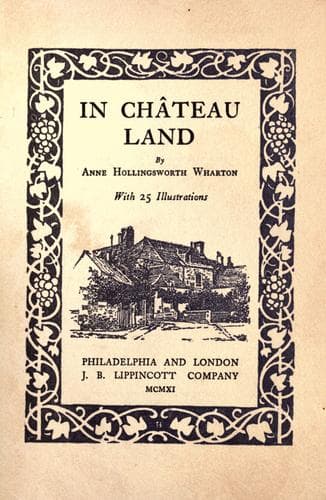
Castles -- France; Touraine (France) -- Description and travel
With a clink of silver and a cheerful "_Au revoir, Mesdames et
Monsieur_," we parted from our pleasant little guide. As we turned to
look back at Amboise from the bridge, some heavy clouds hung over the
castle, making it look grim and gray, more like the fortress-prison that
it had proved to so many hundreds of brave, unfortunate Frenchmen than
the cheerful chateau, basking in the sunshine, that we had seen this
morning.
We motored home, in a fine drizzle of rain, through a gray landscape;
and surely no landscape can be more perfectly gray than that of France
when it is pleased to put on sombre tints, and no other could have been
as well suited to the shade of our thoughts.
Lydia, by way of reviving our drooping spirits, I fancy, as she is not
usually given to conundrums or puzzles, suddenly propounded a series of
brain-racking questions. "Who first said, 'Let us fly and save our
bacon;' and 'He would make three bites of a cherry;' and 'Appetite comes
with eating;' and 'It is meat, drink, and cloth to us;' and----"
"Stop!" cried Miss Cassandra, "and give us time to think, but I am quite
sure that it was Beau Brummel who made three bites of a cherry, or a
strawberry, or some other small fruit."
Walter and I were inclined to give Shakespeare and Pope the credit of
these familiar sayings; but we were all wrong, as Lydia, after puzzling
us for some time, exclaimed triumphantly:
"No, further back than either Shakespeare or Pope; these wise sayings,
and many more like them, were written by a Tourangeau, one Monsieur
Rabelais."
"And where did you come across them?" we asked, quite put out with
Lydia for knowing so much more than the rest of us.
Then Lydia, who appears upon the surface to be a guileless and
undesigning young person, confessed that she had extracted this
information from a Frenchman with whom we all had some pleasant
conversation on the way to Langeais, and she has been treasuring it up
ever since to spring it upon us in an unguarded moment when we were far
from the haunts of Rabelais. This gentleman, whose name is one of the
things we shall probably never know, with the cheerfully appropriating
spirit of the French, was ready to claim most of Shakespeare's aphorisms
for Rabelais. We are willing to forgive him, however, because he
introduced us to a phrase coined by the creator of Pantagruel, in
slow-going sixteenth century days, which so exactly fits the situation
to-day that it seems to have been made for such travellers as ourselves:
"Nothing is so dear and precious as time," wrote M. Rabelais, long
before tourists from all over the world were trying to live here on
twenty-four hours a day and yet see all the chateaux and castles upon
their lists.
Public-domain text, read in full here on John Shaqi.
Reviews
Reviews
No reviews yet
Be the first to share your thoughts on this work.
Join the Discussion
Join the discussion
Sign in to leave a comment or review.
Sign InorCreate an account