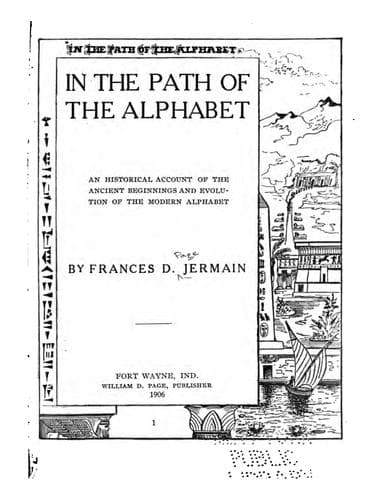
In the path of the alphabet: an historical account of the ancient beginnings and evolution of the modern alphabet — John Shaqi
In the path of the alphabet: an historical account of the ancient beginnings and evolution of the modern alphabetJermain, Frances Delavan Page
History
In the path of the alphabet: an historical account of the ancient beginnings and evolution of the modern alphabet
Jermain, Frances Delavan Page
Alphabet
The ruins where they were found were at first supposed to have been the
remains of the royal residence, but further examination indicates this
structure as the depository of the royal archives, the abode of the
king’s scribe and custodian of documents. It was near the palace though
not of it. A portion of these documents were placed in the museum at
Cairo, some were obtained for the British Museum, and the remainder by
the Royal Museum of Berlin. They include in all three hundred letters
from kings of Babylonia, Assyria, Mesopotamia and northern Syria, and
from subject princes and governors in Palestine and throughout Canaan.
Although in cuneiform script, these characters varied with the locality
from whence they came. The indications are that this system of writing
had been long in use throughout western Asia.
The language chiefly used in these documents was the Semitic Babylonian,
in the syllabary of the older Turanian form. In one or two cases the
writer uses the Babylonian script to express his native language, the
speech of the locality from whence the letter was sent, but these
instances are rare.
In one letter from Tushratta, or Dusratta, king of Mitanni, the first
seven lines are in Assyrian, but after this the remaining five hundred
and five lines are in his native language, the speech of Mitanni, a
language as yet unknown, having never been translated.
The meanings of a few words have been determined by Dr. Sayce and other
scholars and the indications are that the language was a Mongol dialect,
akin to the Accadian. The similarity of some words to those used by the
Hittite prince, Tarkondara, who also writes about this time to Amenophis
III, indicates this to be of the same family of speech.
The writing of this document is syllabic; and in the older cuneiform,
with very few determinatives.
In some later explorations at Tel-el-Amarna Mr. Petrie came upon some
fragments of other tablets in cuneiform which proved to be dictionaries.
“In one case the dictionary expresses Semitic Babylonian and Sumerian,
and as the Sumerian words are written phonetically as well as
ideographically, it would appear that Sumerian must have been still a
living language.”
On one of these later found tablets, Babylonian words are given to
explain words of two other languages, one of which Mr. Boscawen thinks
to be old Egyptian. If this is the case it is the only instance in the
Tel-el-Amarna collections where this appears. In no other portion of
this correspondence is the language of Egypt used.
Throughout the vast region represented by these letters, including
various races and forms of speech, from the upper Euphrates to
Babylonia; from northern Syria to southern Palestine; everywhere, the
Babylonian language and Babylonian script were the common medium of
literary intercourse in this correspondence.
Public-domain text, read in full here on John Shaqi.
Reviews
Reviews
No reviews yet
Be the first to share your thoughts on this work.
Join the Discussion
Join the discussion
Sign in to leave a comment or review.
Sign InorCreate an account