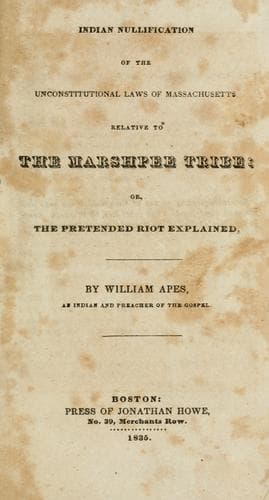
Indian Nullification of the Unconstitutional Laws of Massachusetts Relative to the Marshpee Tribe: Or, the Pretended Riot Explained — John Shaqi
Indian Nullification of the Unconstitutional Laws of Massachusetts Relative to the Marshpee Tribe: Or, the Pretended Riot ExplainedApess, William
History
Indian Nullification of the Unconstitutional Laws of Massachusetts Relative to the Marshpee Tribe: Or, the Pretended Riot Explained
Apess, William
Indians of North America -- Legal status, laws, etc.; Mashpee Indians -- Land tenure; Mashpee Indians -- Legal status, laws, etc.
[This, it is said, enables the Overseers to sanction the
accounts of those who sell to the Indians upon the expectation
of obtaining the favor of the Overseers, and opens a door for
connivance.]
SECT. 4. The Overseers are to keep a fair account of all
monies, wages, &c. they receive, and all proceeds of the
plantation, and shall distribute to the proprietors their
respective shares and dues, after deducting reasonable expense
of conducting their business, _paying their just debts_, (of
which the Overseers are made the judges,) and providing for
the sick and indigent, from the common profits, and reserving
such sums as can be spared conveniently, for the support of
religious instruction, and schooling children. The accounts to
be laid before the Governor annually. The Governor and Council
appoint the Overseers and displace them at pleasure.
SECT. 5. The Indian Proprietors are prohibited giving any one
liberty to cut wood, timber or hay, to milk pine trees, carry
off any ore or grain, or to plant or improve any land
or tenement, and no such liberty, unless approved by the
Overseers, shall bar an action on the part of the Overseers to
recover. The lands shall not be taken in execution for debt,
and an Indian committed for debt may take the poor
debtor's oath, his being a _proprietor_ to the contrary
notwithstanding.
The last act relating to this tribe, was passed Feb. 18, 1819,
Chap. 105, 2d vol. of Laws, page 487. It provides that no
person thereafter shall be a proprietor of the Plantation,
except a child or lineal descendant of some proprietor, and in
no other way shall this _right_, as it is called, be acquired.
Other inhabitants are called members of the tribe.
The Overseers are to keep a record of names, or census, of all
who are proprietors, and all who are residents or members of
the tribe, a return of which is to be made to the Governor the
last of December.
The Overseers, in addition to all former power, are invested
with all the powers and duties of guardians of the Indians,
whenever such office of guardian shall be vacant. [A very
blind provision, by the way, which it may be as difficult for
white men as for Indians to understand.]
Any person selling ardent spirits to an Indian, without
a permit in writing from the Overseer, from some agent of
theirs, or from a respectable physician, may be fined not more
than fifty dollars, on conviction; and it shall be the duty
of the Overseer to give information for prosecuting such
offenders.
The Overseers may bind out to service, for three years at
a time, any proprietor or member of the tribe, who in their
judgment has become an habitual drunkard and idler, and they
may apply his earnings to his own support, his family's, or
the proprietors generally, as they think proper.
Public-domain text, read in full here on John Shaqi.
Reviews
Reviews
No reviews yet
Be the first to share your thoughts on this work.
Join the Discussion
Join the discussion
Sign in to leave a comment or review.
Sign InorCreate an account