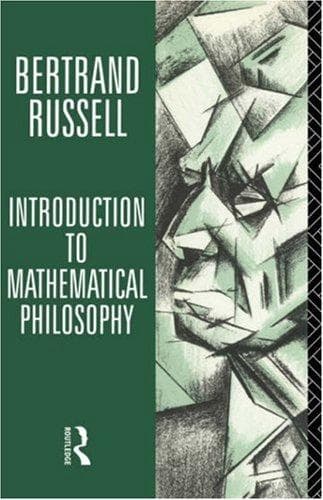
Introduction to Mathematical PhilosophyRussell, Bertrand
Philosophy
Introduction to Mathematical Philosophy
Russell, Bertrand
Mathematics -- Philosophy
A term is said to be a "maximum" of a class with respect
to a relation if is a member of and
of the field of and does
not have the relation to any other member of .
These definitions do not demand that the terms to which
they are applied should be quantitative. For example, given
a series of moments of time arranged by earlier and later, their
"maximum" (if any) will be the last of the moments; but if
they are arranged by later and earlier, their "maximum" (if
any) will be the first of the moments.
The "minimum" of a class with respect to is its maximum
with respect to the converse of ; and the "lower limit" with
respect to is the upper limit with respect to the
converse of .
The notions of limit and maximum do not essentially demand
that the relation in respect to which they are defined should
be serial, but they have few important applications except to
cases when the relation is serial or quasi-serial. A notion which
is often important is the notion "upper limit or maximum,"
to which we may give the name "upper boundary." Thus the
"upper boundary" of a set of terms chosen out of a series is
their last member if they have one, but, if not, it is the first
term after all of them, if there is such a term. If there is neither
[Pg 70]
a maximum nor a limit, there is no upper boundary. The
"lower boundary" is the lower limit or minimum.
Reverting to the four kinds of Dedekind section, we see that
in the case of the first three kinds each section has a boundary
(upper or lower as the case may be), while in the fourth kind
neither has a boundary. It is also clear that, whenever the
lower section has an upper boundary, the upper section has
a lower boundary. In the second and third cases, the two
boundaries are identical; in the first, they are consecutive
terms of the series.
A series is called "Dedekindian" when every section has a
boundary, upper or lower as the case may be.
We have seen that the series of ratios in order of magnitude
is not Dedekindian.
From the habit of being influenced by spatial imagination,
people have supposed that series must have limits in cases where
it seems odd if they do not. Thus, perceiving that there was
no rational limit to the ratios whose square is less than 2, they
allowed themselves to "postulate" an irrational limit, which
was to fill the Dedekind gap. Dedekind, in the above-mentioned
work, set up the axiom that the gap must always be filled, i.e.
that every section must have a boundary. It is for this reason
that series where his axiom is verified are called "Dedekindian."
But there are an infinite number of series for which it is not
verified.
The method of "postulating" what we want has many advantages;
they are the same as the advantages of theft over honest
toil. Let us leave them to others and proceed with our honest toil.
Public-domain text, read in full here on John Shaqi.
Reviews
Reviews
No reviews yet
Be the first to share your thoughts on this work.
Join the Discussion
Join the discussion
Sign in to leave a comment or review.
Sign InorCreate an account