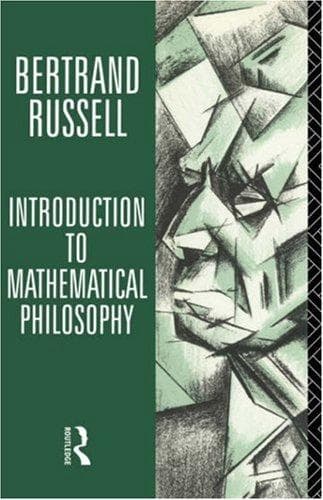
Introduction to Mathematical Philosophy — John Shaqi
Introduction to Mathematical PhilosophyRussell, Bertrand
Philosophy
Introduction to Mathematical Philosophy
Russell, Bertrand
Mathematics -- Philosophy
It is easy to prove that the series of segments of any series
is Dedekindian. For, given any set of segments, their boundary
will be their logical sum, i.e. the class of all those terms that
belong to at least one segment of the set.[18]
[18]For a fuller treatment of the subject of segments and Dedekindian
relations, see Principia Mathematica, vol. II. * 210-214. For a fuller
treatment of real numbers, see ibid., vol. III. * 310 ff., and
Principles of Mathematics, chaps. XXXIII. and XXXIV.
The above definition of real numbers is an example of "construction"
as against "postulation," of which we had another
example in the definition of cardinal numbers. The great
advantage of this method is that it requires no new assumptions,
but enables us to proceed deductively from the original apparatus
of logic.
There is no difficulty in defining addition and multiplication
for real numbers as above defined. Given two real numbers
and , each being a class of ratios, take any member of and
any member of and add them together according to the rule
for the addition of ratios. Form the class of all such sums
obtainable by varying the selected members of and . This
gives a new class of ratios, and it is easy to prove that this new
class is a segment of the series of ratios. We define it as the
sum of and . We may state the definition more shortly as
follows:—
The arithmetical sum of two real numbers is the class of the
arithmetical sums of a member of the one and a member of the
other chosen in all possible ways.
[Pg 73]
We can define the arithmetical product of two real numbers
in exactly the same way, by multiplying a member of the one by
a member of the other in all possible ways. The class of ratios
thus generated is defined as the product of the two real numbers.
(In all such definitions, the series of ratios is to be defined as
excluding 0 and infinity.)
There is no difficulty in extending our definitions to positive
and negative real numbers and their addition and multiplication.
It remains to give the definition of complex numbers.
Public-domain text, read in full here on John Shaqi.
Reviews
Reviews
No reviews yet
Be the first to share your thoughts on this work.
Join the Discussion
Join the discussion
Sign in to leave a comment or review.
Sign InorCreate an account