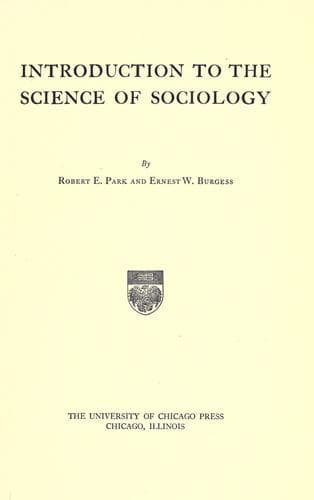
Introduction to the Science of SociologyPark, Robert Ezra
General
Introduction to the Science of Sociology
Park, Robert Ezra
Sociology
The original in conduct, that is to say, resistiveness to the
voice of the herd, will be suppressed by natural selection; the
wolf which does not follow the impulses of the herd will be
starved; the sheep which does not respond to the flock will be
eaten.
Again, not only will the individual be responsive to impulses
coming from the herd, but he will treat the herd as his normal
environment. The impulse to be in and always to remain with the
herd will have the strongest instinctive weight. Anything which
tends to separate him from his fellows, as soon as it becomes
perceptible as such, will be strongly resisted.[34]
According to sociologists of this school, public opinion, conscience,
and authority in the state rest upon the natural disposition of the
animal in the herd to conform to "the decrees of the herd."
Conscience, then, and the feelings of guilt and of duty are the
peculiar possessions of the gregarious animal. A dog and a cat
caught in the commission of an offence will both recognize that
punishment is coming; but the dog, moreover, knows that he has
done _wrong_, and he will come to be punished, unwillingly it
is true, and as if dragged along by some power outside him,
while the cat's sole impulse is to escape. The rational
recognition of the sequence of act and punishment is equally
clear to the gregarious and to the solitary animal, but it is
the former only who understands that he has committed a
_crime_, who has, in fact, the _sense of sin_.[35]
The concepts upon which this explanation of society rests is
_homogeneity_. If animals or human beings act under all circumstances in
the same way, they will act or seem to act, as if they had a common
purpose. If everybody follows the crowd, if everyone wears the same
clothes, utters the same trite remarks, rallies to the same battles
cries and is everywhere dominated, even in his most characteristically
individual behavior, by an instinctive and passionate desire to conform
to an external model and to the wishes of the herd, then we have an
explanation of everything characteristic of society--except the
variants, the nonconformists, the idealists, and the rebels. The herd
instinct may be an explanation of conformity but it does not explain
variation. Variation is an important fact in society as it is in nature
generally.
Public-domain text, read in full here on John Shaqi.
Reviews
Reviews
No reviews yet
Be the first to share your thoughts on this work.
Join the Discussion
Join the discussion
Sign in to leave a comment or review.
Sign InorCreate an account