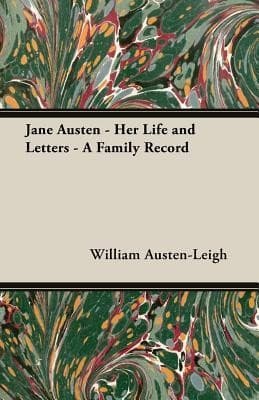
Jane Austen, Her Life and Letters: A Family Record — John Shaqi
Jane Austen, Her Life and Letters: A Family RecordAusten-Leigh, William
General
Jane Austen, Her Life and Letters: A Family Record
Austen-Leigh, William
Austen, Jane, 1775-1817; Austen, Jane, 1775-1817 -- Family; Novelists, English -- 19th century -- Family relationships
The eldest brother of the family, James, was nearly eleven years older
than Jane, and had taken his degree at Oxford before she left school. He
had matriculated at St. John's (where he obtained a 'founder's kin'
Scholarship and, subsequently, a Fellowship) in 1779, at the early age
of fourteen; his departure from home having been perhaps hastened in
order to make room for the three or four pupils who were sharing his
brothers' studies at that time. His was a scholarly type of mind; he was
well read in English literature, had a correct taste, and wrote readily
and happily, both in prose and verse. His son, the author of the
_Memoir_, believes that he had a large share in directing the reading,
and forming the taste, of his sister Jane. James was evidently in
sympathy with Cowper's return to nature from the more artificial and
mechanical style of Pope's imitators, and so was she; in _Sense and
Sensibility_, Marianne, after her first conversation with Willoughby,
had happily assured herself of his admiring Pope 'no more than is
proper.' In 1786 we hear of James being in France; his cousin Eliza was
hoping for a visit of some months from him; but in the next year he had
returned, and he must have soon gone into residence at Oxford as a
young Fellow of his College; for there, in 1789, he became the
originator and chief author of a periodical paper called _The Loiterer_,
modelled on _The Spectator_ and its successors. It existed for more than
a twelvemonth, and in the last number the whole was offered to the world
as a 'rough, but not entirely inaccurate Sketch of the Character, the
Manners, and the Amusements of Oxford, at the close of the eighteenth
century.' In after life, we are told, he used to speak very slightingly
of this early work, 'which he had the better right to do, as, whatever
may have been the degree of their merits, the best papers had certainly
been written by himself.'
Public-domain text, read in full here on John Shaqi.
Reviews
Reviews
No reviews yet
Be the first to share your thoughts on this work.
Join the Discussion
Join the discussion
Sign in to leave a comment or review.
Sign InorCreate an account