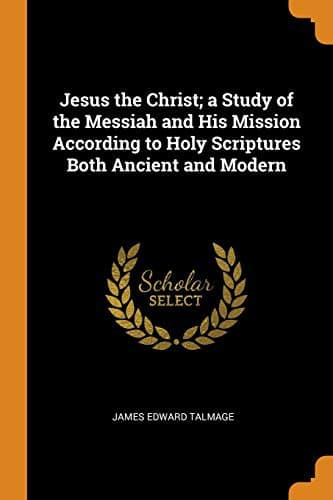
Jesus the Christ: A Study of the Messiah and His Mission According to Holy; Scriptures Both Ancient and ModernTalmage, James E. (James Edward)
Religion
Jesus the Christ: A Study of the Messiah and His Mission According to Holy; Scriptures Both Ancient and Modern
Talmage, James E. (James Edward)
Christian biography -- Palestine; Jesus Christ -- Biography; Jesus Christ -- Mormon interpretations
Eusebius, who lived between 260 and 339 A.D., and is known in
ecclesiastical history as Bishop of Cæsarea, wrote: "At the time that
Herod was king, who was the first foreigner that reigned over the Jewish
people, the prophecy recorded by Moses received its fulfilment, viz.
'That a prince should not fail of Judah, nor a ruler from his loins,
until He should come for whom it is reserved, the expectation of
nations.'" (The quoted passage is founded on the Septuagint rendering of
Genesis 49:10).
Some critics have held that in Jacob's use of the word "Shiloh" he did
not intend it as a name or proper noun at all. The writer of the article
"Shiloh" in Cassell's _Bible Dictionary_ says: "The preponderance of
evidence is in favor of the Messianic interpretation, but opinions are
very divided respecting the retention of the word 'Shiloh' as a proper
name.... Notwithstanding all the objections that are urged against it
being so regarded, we are of the opinion that it is rightly considered
to be a proper name, and that the English version represents the true
sense of the passage. We recommend those who wish to enter more fully
into a question which cannot well be discussed without Hebrew criticism,
to the excellent notes upon Gen. 49:10 in the 'Commentary on the
Pentateuch' by Keil and Delitzsch. Here the text is thus rendered: 'The
sceptre shall not depart from Judah, nor the ruler's staff from between
his feet, till Shiloh come, and the willing obedience of the nations be
to him.'
"Notwithstanding the slight put upon the Messianic interpretation by
some writers, even those from whom we should scarcely expect it, we see
this explanation confirmed and not weakened in the events of history.
The text is not taken to mean that Judah should at no time be without a
royal ruler of his own, but that the regal power should not finally
cease from Judah until Shiloh had come. The objections founded on the
Babylonian captivity, and similar intermissions, are of no force,
because it is the complete and final termination which is pointed out,
and that only happened after the time of Christ." See further _The Book
of Prophecy_, by G. Smith, LL.D., p. 320. See also _Compendium of the
Doctrines of the Gospel_, by Franklin D. Richards and James A. Little,
article "Christ's First Coming."
Public-domain text, read in full here on John Shaqi.
Reviews
Reviews
No reviews yet
Be the first to share your thoughts on this work.
Join the Discussion
Join the discussion
Sign in to leave a comment or review.
Sign InorCreate an account