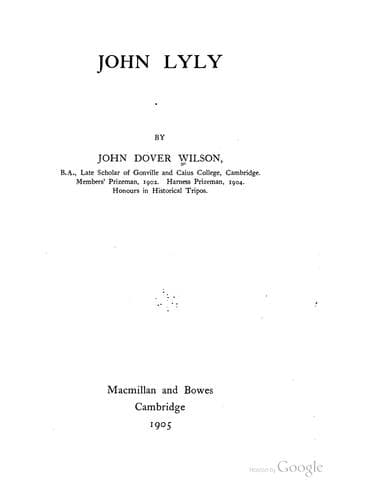
Lyly, John, 1554?-1606 -- Criticism and interpretation
It is however in Lyly's treatment of the subject of love that the change
is most conspicuous. The subtleties of passion are now realised for the
first time. We are shown the private emotions, the secret alternations
of hope and despair which agitate the breasts of man and maid, and,
more important still, we find these emotions at work under the restraint
of social conditions; the violent torrent of passion checked and
confined by the demands of etiquette and the conventions of aristocratic
life. The relation between these unwritten laws of our social
constitution and the impetuous ardour of the lover, has formed the main
theme of our modern love stories in the novel and on the stage. In the
days of chivalry, when love ran wild in the woods, woman was the passive
object either of hunt or of rescue; but the scene of battle being
shifted to the boudoir she can demand her own conditions with the result
that the game becomes infinitely more refined and intricate. Persons of
both sexes, outwardly at peace but inwardly armed to the teeth, meet
together in some lady's house to discuss the subject so dangerous to
both, and conversation conditioned by this fact inevitably becomes
subtle, allusive, intense; for it derives its light and shade from the
flicker of that fire which the company finds such a perilous fascination
in playing with. Lyly's work does not exhibit quite such modernity as
this, but we may truthfully say that his _Euphues and his England_ is
the psychological novel in germ.
Public-domain text, read in full here on John Shaqi.
Reviews
Reviews
No reviews yet
Be the first to share your thoughts on this work.
Join the Discussion
Join the discussion
Sign in to leave a comment or review.
Sign InorCreate an account