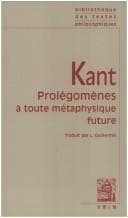
Kant's Prolegomena to Any Future MetaphysicsKant, Immanuel
PhilosophyPhilosophy
Kant's Prolegomena to Any Future Metaphysics
Kant, Immanuel
Knowledge, Theory of -- Early works to 1800; Metaphysics -- Early works to 1800
But the understanding begins its aberrations very innocently and
modestly. It first elucidates the elementary cognitions, which inhere
in it prior to all experience, but yet must always have their
application in experience. It gradually drops these limits, and what
is there to prevent it, as it has quite freely derived its principles
from itself? And then it proceeds first to newly-imagined powers in
nature, then to beings, outside nature; in short to a world, for whose
construction the materials cannot be wanting, because fertile fiction
furnishes them abundantly, and though not confirmed, is never refuted,
by experience. This is the reason that young thinkers are so partial
to metaphysics of the truly dogmatical kind, and often sacrifice to it
their time and their talents, which might be otherwise better
employed.
But there is no use in trying to moderate these fruitless endeavors of
pure reason by all manner of cautions as to the difficulties of
solving questions so occult, by complaints of the limits of our
reason, and by degrading our assertions into mere conjectures. For if
their impossibility is not distinctly shown, and reason's cognition of
its own essence does not become a true science, in which the field of
its right use is distinguished, so to say, with mathematical certainty
from that of its worthless and idle use, these fruitless efforts will
never be abandoned for good.
§ 36. How is Nature itself possible?
This question—the highest point that transcendental philosophy can
ever reach, and to which, as its boundary and completion, it must
proceed—properly contains two questions.
First: How is nature at all possible in the material sense, by
intuition, considered as the totality of appearances; how are space,
time, and that which fills both—the object of sensation, in general
possible? The answer is: By means of the constitution of our
Sensibility, according to which it is specifically affected by
objects, which are in themselves unknown to it, and totally distinct
from those phenomena. This answer is given in the Critique itself in
the transcendental Aesthetic, and in these Prolegomena by the solution
of the first general problem.
Secondly: How is nature possible in the formal sense, as the totality
of the rules, under which all phenomena must come, in order to be
thought as connected in experience? The answer must be this: It is
only possible by means of the constitution of our Understanding,
according to which all the above representations of the sensibility
are necessarily referred to a consciousness, and by which the peculiar
way in which we think (viz., by rules), and hence experience also, are
possible, but must be clearly distinguished from an insight into the
objects in themselves. This answer is given in the Critique itself in
the transcendental Logic, and in these Prolegomena, in the course of
the solution of the second main problem.
Public-domain text, read in full here on John Shaqi.
Reviews
Reviews
No reviews yet
Be the first to share your thoughts on this work.
Join the Discussion
Join the discussion
Sign in to leave a comment or review.
Sign InorCreate an account