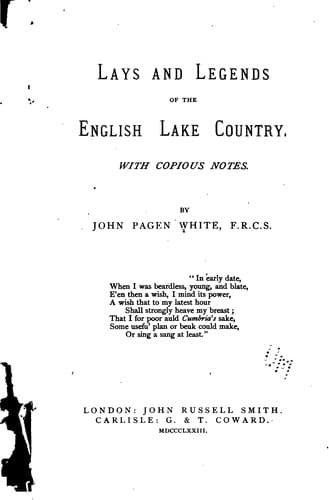
Lays and Legends of the English Lake Country: With Copious NotesWhite, John Pagen
General
Lays and Legends of the English Lake Country: With Copious Notes
White, John Pagen
Lake District (England) -- Poetry; Legends -- England -- Lake District
"Two years after, on Midsummer Eve also, betwixt the hours of
eight and nine, William Lancaster himself imagined that several
gentlemen were following their horses at a distance, as if they had
been hunting, and taking them for such, paid no regard to it, till
about ten minutes after, again turning his head to the place, they
appeared to be mounted, and a vast army following, five in rank,
crowding over at the same place, where the servant said he saw them
two years before. He then called his family, who all agreed in
the same opinion; and what was most extraordinary, he frequently
observed that some one of the five would quit the rank, and seem to
stand in a fronting posture, as if he was observing and regulating
the order of their march, or taking account of the numbers, and
after some time appeared to return full gallop to the station he
had left, which they never failed to do as often as they quitted
their lines, and the figure that did so was one of the middlemost
men in the rank. As it grew later they seemed more regardless of
discipline, and rather had the appearance of people riding from
a market, than an army, though they continued crowding on, and
marching off, as long as they had light to see them.
"This phenomenon was no more seen till the Midsummer Eve, which
preceded the rebellion, when they were determined to call more
families to witness this sight, and accordingly went to Wiltonhill
and Souther Fell-side, till they convened about twenty-six persons,
who all affirm that they saw the same appearance, but not conducted
with the usual regularity as the preceding ones, having the
likeness of carriages interspersed; however it did not appear to be
less real, for some of the company were so affected with it as in
the morning to climb the mountain, through an idle expectation of
finding horse shoes, after so numerous an army, but they saw not a
vestige or print of a foot.
"William Lancaster, indeed, told me, that he never concluded they
were real beings, because of the impracticability of a march over
the precipices, where they seemed to come on; that the night was
extremely serene; that horse and man, upon strict looking at,
appeared to be but one being, rather than two distinct ones; that
they were nothing like any clouds or vapours, which he had ever
perceived elsewhere; that their number was incredible, for they
filled lengthways near half a mile, and continued so in a swift
march for above an hour, and much longer he thinks if night had
kept off."
Public-domain text, read in full here on John Shaqi.
Reviews
Reviews
No reviews yet
Be the first to share your thoughts on this work.
Join the Discussion
Join the discussion
Sign in to leave a comment or review.
Sign InorCreate an account