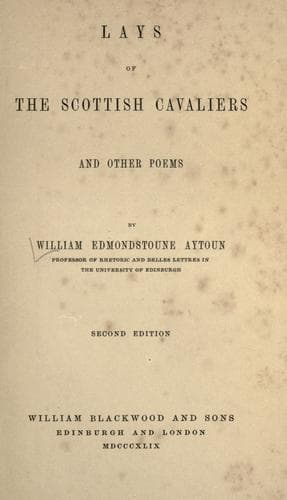
Lays of the Scottish Cavaliers and Other PoemsAytoun, William Edmondstoune
History
Lays of the Scottish Cavaliers and Other Poems
Aytoun, William Edmondstoune
Scotland -- History -- Poetry
With a force which, at the battle of Preston, did not double the above
numbers, the Prince descended upon the Lowlands, having baffled the
attempts of General Cope to intercept his march--occupied the city of
Perth and the town of Dundee, and finally, after a faint show of
resistance on the part of the burghers, took possession of the ancient
capital of Scotland, and once more established a court in the halls of
Holyrood. His youth, his gallantry, and the grace and beauty of his
person, added to a most winning and affable address, acquired for him
the sympathy of many who, from political motives, abstained from
becoming his adherents. Possibly certain feelings of nationality, which
no deliberate views of civil or religious policy could altogether
extirpate, led such men to regard, with a sensation akin to pride, the
spectacle of a prince descended from the long line of Scottish kings,
again occupying his ancestral seat, and restoring to their country,
which had been utterly neglected by the new dynasty, a portion of its
former state. No doubt a sense of pity for the probable fate of one so
young and chivalrous was often present to their minds, for they had
thorough confidence in the intrepidity of the regular troops, and in the
capacity of their commander; and they never for a moment supposed that
these could be successfully encountered by a raw levy of undisciplined
Highlanders, ill-armed and worse equipped, and without the support of
any artillery.
The issue of the battle of Prestonpans struck Edinburgh with amazement.
In point of numbers the two armies were nearly equal, but in every thing
else, save personal valour, the royal troops had the advantage. And yet,
_in four minutes_--for the battle is said not to have lasted
longer--the Highlanders having only made one terrific and impetuous
charge--the rout of the regulars was general. The infantry was broken
and cut to pieces; the dragoons, who behaved shamefully on the occasion,
turned bridle and fled, without having once crossed swords with the
enemy. Mr. Chambers thus terminates his account of the action: "The
general result of the battle of Preston may be stated as having been the
total overthrow and almost entire destruction of the royal army. Most of
the infantry, falling upon the park walls of Preston, were there huddled
together, without the power of resistance, into a confused drove, and
had either to surrender or to be cut to pieces. Many, in vainly
attempting to climb over the walls, fell an easy prey to the ruthless
claymore. Nearly 400, it is said, were thus slain, 700 taken, while only
about 170 in all succeeded in effecting their escape.
Public-domain text, read in full here on John Shaqi.
Reviews
Reviews
No reviews yet
Be the first to share your thoughts on this work.
Join the Discussion
Join the discussion
Sign in to leave a comment or review.
Sign InorCreate an account