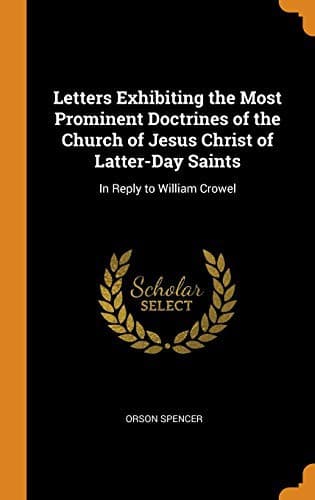
Letters Exhibiting the Most Prominent Doctrines of the Church of Jesus Christ of Latter-Day SaintsSpencer, Orson
Religion
Letters Exhibiting the Most Prominent Doctrines of the Church of Jesus Christ of Latter-Day Saints
Spencer, Orson
Church of Jesus Christ of Latter-day Saints -- Doctrines; Latter Day Saint churches -- Doctrines
God's holy dwelling place, is literal, local, real, and to its
occupants, it is visible and tangible. It is by no means a matterless,
passionless, mystical region of extatic and endless songs from the
lips of immaterial spirits, offered in praise to some Great Spirit,
equally passionless and immaterially chaotic, spreading infinitely
through all space without centre or circumference. If such is the God
that men expect to adore in heaven, mankind would present but a faint
image of him, yea, even Jesus, who partook of man's likeness, could not
have been the brightness of the Father's glory, and express image of
his person. He declares that He has given us an image and likeness of
himself in the person of man. But who would ever recognise their Father
and Jesus in the person of a boundless, centreless being, of no body or
parts, infinitely expanded.
But it is sometimes urged that man only resembles God in his moral
attributes. Morally, says the divine and doctor, man bears the image
of God. Aye, indeed! The absurdity of such a supposition is still
greater. By moral, I must then understand, that the resemblance
between God and man, consists in their being of like social, civil,
and religious temperament and affection. Other things being equal, a
holy man as Adam originally was, would cherish the same propensities
with God--have a similar sense of justice and truth according to the
measure of knowledge belonging to each. But the absurdity and query
are here: an immaterial, infinitely expanded God, without physical
form and locality, is as unlike to man as light to darkness, or as the
most diverse animals can be supposed to be, and cannot in the nature
of things have those sympathies and moral sensibilities that man has.
Material sensibilities must differ from those which are immaterial, as
much as the elements of land and water differ.
My sheet being full, allow me to subscribe myself
Your friend and servant,
ORSON SPENCER.
LETTER IX.
THE PRIESTHOOD.
_Liverpool, September_ 30, 1847.
Reverend and Dear Sir,--In close connexion with an account of the
character of God, I will proceed to give you a brief and succint
description of THE PRIESTHOOD. It is feared, however, that the present
subject will not be more congenial to your views than the foregoing.
Still it shall be treated according to the spirit of the scriptures of
the Old and New Testament, which you ardently profess to believe.
You will admit that God is the righteous Ruler over all the moral and
intelligent creatures of the universe. His government is both temporal
and spiritual. Not even a sparrow falls to the ground without His
notice. He clothes the lilies of the field; much more doth He watch
over all the varied interests of intelligent beings both in heaven and
upon earth.
Public-domain text, read in full here on John Shaqi.
Reviews
Reviews
No reviews yet
Be the first to share your thoughts on this work.
Join the Discussion
Join the discussion
Sign in to leave a comment or review.
Sign InorCreate an account