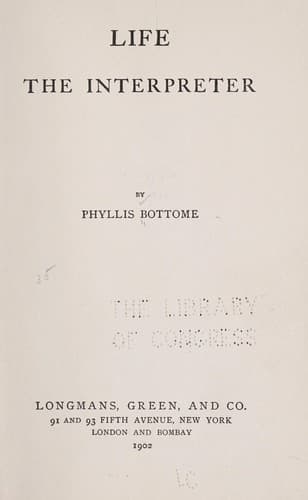
East End (London, England) -- Fiction; London (England) -- Social conditions -- Fiction; Social settlements -- Fiction
He had not meant to find her in London. When he had, and they met again
and yet again, and in fact even from the moment when she had told him
where and how she lived, he had made the great decision.
The locusts should eat no more empty years. If she could forget (_could_
she forget, forgive at least?) that stammering judgment eight years ago,
how happy they would be together! What noble, magnificent work would
they not do—together—and now she had sent him away with no excuse. Had
that self-made barrier of his fallen for another to rise? He smoked hard
and rang the bell. There is always one way of finding out things if a
man has sense and no false pride—to ask. He was going to ask, and he
smiled grimly to himself as he thought of the answer she would give
him—_should_ give him!—if strength and power and purpose went for
anything. The tea-things that were set out for her looked miserable as
only neglected food can look, and the room lost in the gathering
twilight seemed emptily expectant of the guest who had not come.
Leslie Damores cared nothing at all for omens and less for gloom, and
even the fact that he could not find his matches did not evoke a frown.
He was going to see her, and he _meant_ to see her, and he terribly
over-paid the cabman’s fare. How many sullen looks and surly words do we
not owe to the over-generosity of lovers, who appear to think that by
tipping the universe they will earn the reward of Providence in the
shape they most desire? Alas! we human beings are always misplacing our
tips, and then we wonder when the raps that come to us seem to be
misplaced as well!
CHAPTER XX
“God is in all men, but all men are not in God: that is the
reason why they suffer.”
IT was hot, with that intense silken quiver in the air which turns the
atmosphere into a living creature.
That “certain twilight” moment was already beginning to “cut the glory
from the gray,” and across the Indian garden strolled two figures
scarcely conscious of the breathless life, so interested were they in
each other. Gladys Travers, in a well-fitting gown, a cloud of something
soft that sunk into a shower of lovely curves, led the way through the
trees to a seat.
“I call it a summer-house,” she said. “It sounds so English!”
“Ah!” Jack Hurstly answered half wistfully, “you’ve already begun to
hunger for home. We all have it, you know, and try to call the most
un-English things by familiar names, just to trick ourselves into
thinking—Heaven knows what—that it isn’t quite so far away, I
suppose.”
“It seems hardly possible that we have been here two months,” sighed
Gladys. “And it _was_ so strange to find you here!”
Public-domain text, read in full here on John Shaqi.
Reviews
Reviews
No reviews yet
Be the first to share your thoughts on this work.
Join the Discussion
Join the discussion
Sign in to leave a comment or review.
Sign InorCreate an account