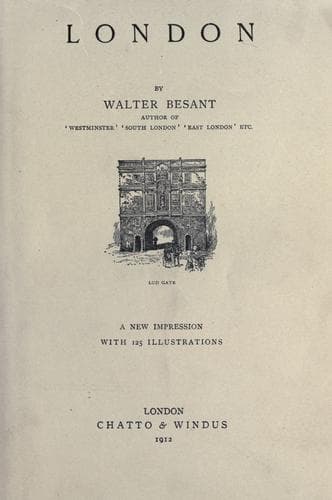
London (England) -- History; London (England) -- Social life and customs
Some day this foundation, with its income of £10,000 a year, must
be sent back to East London, to which it belongs. Poor East London! It
had one--only one--ancient and venerable foundation, and they have
wantonly and uselessly destroyed it.
Everybody who visits London goes to see the Temple Church and the courts
formerly trodden by the Templars, now echoing the hurried feet of
lawyers and their clerks. Their beautiful church, however, is that of
the new Temple. There was an older Temple than this. It stood at the
north-east corner of Chancery Lane. It was certainly some kind of
quadrangular college with its chapel, its hall, its courts, and its
gardens. When the Templars moved to their new quarters, it passed into
other hands and ceased to be a monastic place. Some of its buildings
survived until the sixteenth century.
Is the legend of St. Mary Overies too well-known a story to be retold?
Perhaps there are some readers who have not read the _Chronicles of
London Bridge_, where it is narrated.
[Illustration: DOWGATE DOCK]
Long years ago, before there was any London Bridge at all, a ferry plied
across the river between what is now Dowgate Dock and that now called
St. Saviour's Dock--both of which exist untouched, save that the
buildings round them are changed. At one time the ferry-master--he
appears to have sat at home and taken the money while his servants
tugged at the oar--was one Awdrey. There was no competition in the ferry
trade of the time, so that this worthy employer of labor grew rich. As
he became old, however, he fell into the vice common to rich men who are
also old--that is to say, he became avaricious, covetous, and miserly;
he suffered acutely from this failing, in so much that he grudged his
servants their very food. This miser had a daughter, a lovely damsel
named Mary, of whom many young knights became amorous. To one of these
she lost her heart; and, as too commonly happens, to the poorest, a
thing which her father could not countenance. The knight, therefore, not
being able to get the consent of Awdrey père, removed to another place,
guarding still the memory of his Mary, and still beloved by her. As
there was no post in those days, and neither could write, they exchanged
no letters, but they preserved their constancy and fidelity.
Public-domain text, read in full here on John Shaqi.
Reviews
Reviews
No reviews yet
Be the first to share your thoughts on this work.
Join the Discussion
Join the discussion
Sign in to leave a comment or review.
Sign InorCreate an account