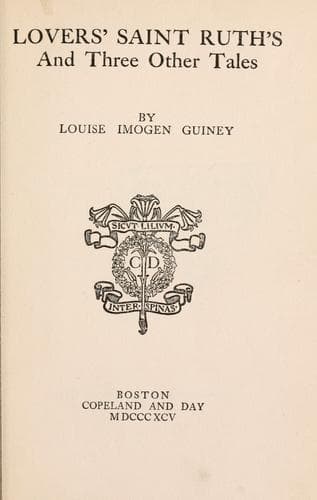
Lovers' Saint Ruth's, and Three Other Tales — John Shaqi
Lovers' Saint Ruth's, and Three Other TalesGuiney, Louise Imogen
General
Lovers' Saint Ruth's, and Three Other Tales
Guiney, Louise Imogen
American fiction -- 19th century; Short stories, American
Hughey had planned out his difficult campaign to the end, and his
brain was quiet and clear. Passing through Church Street, he raised
his hat with reverence, as he had always done since he came to Dublin,
to a blank stone on the south side in the ancient yard of Saint
Michan's; for under that stone, according to a tradition, Robert
Emmett's sentinel dust reposes. There on the old Danish ground, at the
crisis, Winny's fiery Gaelic temper came again to the fore. Struck
with the solitude and the dark, the dread faces of unusual things, and
jostled by the wind which pounced at her from its corner lair on the
north bank of the river, she hung back and rebelled. "Let me go, let
me--go! Hughey! Oh!..." The little silver lisp arose in very real, in
irresistible alarm.
Never once, in all his mistaken planning, had Hughey paused to consider
that she had a voice in the matter. If she were unwilling to die for
his dearest, why, what right had he, Hughey, though scornful and
disappointed because of it, to compel her? After all, she was only
seven, and silly! He looked at Nora over the capped head between them.
Then he fetched a deep, deep sigh, and the tears came to his eyelids,
burned, and dried.
They went on, ever slower; and at Richmond Bridge Hughey spoke to
Winny, as he felt that he could do at last, tenderly, and even with
humorous understanding. "Now 'tis the end o' your walk, an' ye'll trot
home wid Nora, and niver moind me at all, dear. Some day she'll be
tellin' ye phwhat ye missed." But to Nora herself he said softly:
"Take care o' mother, mavourneen."
"Oi will, Hughey."
She kissed him twice; her smooth cheek against his was cold as a shell.
He made a gesture of dismissal, which she did not disobey; and he
watched them go, without further sign. The two childish figures were
swallowed by the blue-black shadows, and the pavement under their naked
feet gave forth no receding sounds. Yet Hughey, bereft of them so
quickly and utterly, listened, listened, tiptoeing to the central arch
of the bridge.
The autumnal Sabbath breath of the slumbering capital floated in a
faint white mist against the brick and stone. Every high point was
alive with light: the masts in port, the roof of the King's Inns, the
Park, the top of the Nelson monument, the Castle standard, the nigh
summits of the gracious Wicklow hills. Below were the dim line of
Liffey bridges, processional to the sea, and the sad friendly wash of
the chilly water. Clear of any regret or self-pity, he would have his
farewell grave and calm, and he would set out with the sign of faith.
So he knelt down, in prayer, for a moment, and with his eyes still
closed, dropped forward.
In another eternal instant, he came into the air. He had a confused
sense of being glad for Winny, and otherwise quite satisfied and
thankful. There, next the wall, was a rotten abandoned raft, a chance
of life within clutch; he saw it, and smiled. Then Hughey sank, and the
black ebb-tide took him.
Public-domain text, read in full here on John Shaqi.
Reviews
Reviews
No reviews yet
Be the first to share your thoughts on this work.
Join the Discussion
Join the discussion
Sign in to leave a comment or review.
Sign InorCreate an account