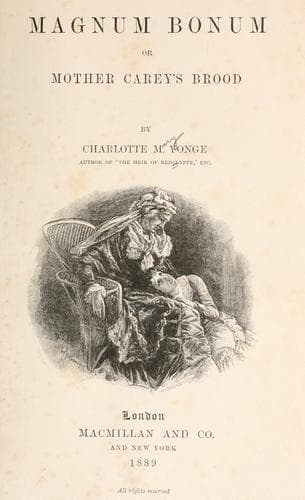
Magnum Bonum; Or, Mother Carey's BroodYonge, Charlotte M. (Charlotte Mary)
General
Magnum Bonum; Or, Mother Carey's Brood
Yonge, Charlotte M. (Charlotte Mary)
Domestic fiction; England -- Social life and customs -- 19th century -- Fiction; Religious fiction
With which they tried to make their way back to the path again, but it
was not immediately to be found; and their progress was further impeded
by a wood-pigeon dwelling impressively on the notes “Take two cows,
Taffy; Taffy take TWO!” and then dashing out, flapping and grey, in
their faces, rather to Barbara’s alarm, and then by Armine’s stumbling
on his first bird’s nest, a wren’s in the moss of an old stump, where
the tiny bird unadvisedly flew out of her leafy hole full before their
eyes. That was a marvel of marvels, a delight equal to that felt by
any explorer the world has seen. Armine and Barbara, who lived in one
perpetual fairy tale, were saying to one another that
“One needn’t make believe here, it was every bit real.”
“And more;” added the other little happy voice. Barbara did however
begin to think of the numerous children in the wood, and to take comfort
that it was unprecedented that their mother and big brother should be
with them, but they found the park palings at last, and then a little
wicket gate, where they were very near home.
“Mother, where _have_ you been?” exclaimed Janet, somewhat suddenly
emerging from the door.
“In Tom Tiddler’s ground, picking up gold and silver,” said Carey,
pointing to the armsful of king-cups, cuckoo-flowers, and anemones,
besides blue-bells, orchises, primroses, &c. “My poor child, it was a
great shame to leave you, but they got me into the enchanted land and I
forgot all about everything.”
“I think so,” said a gravely kind voice, and Caroline was aware of
Ellen’s eye looking at her as the Court Queen might have looked at
Ophelia if she had developed her taste for “long purples” as Hamlet’s
widow. At least so it struck Mother Carey, who immediately became
conscious that her bonnet was awry, having been half pulled off by a
bramble, that her ankles were marked by the bog, and that bits of green
were sticking all over her.
“Have you been helping Janet? Oh, how kind!” she said, refreshed by her
delightsome morning into putting a bright face on it.
“We have done all we could in your absence,” said her sister-in-law, in
a reproachful voice.
“Thank you; I’m sure it is very good of you. Janet--Janet, where’s the
great Dutch bowl--and the little Salviati? Nothing else is worthy of
this dear little fairy thing.”
“What is it? Just common wood-sorrel,” said the other lady, in utter
amaze.
“Ah, Ellen, you think me demented. You little know what it is to see
spring for the first time. Ah! that’s right, Janet. Now, Babie, we’ll
make a little bit of fairy-land--”
“Don’t put all those littering flowers on that nice clean chintz,
children,” exclaimed the aunt, as though all her work were about to be
undone.
Public-domain text, read in full here on John Shaqi.
Reviews
Reviews
No reviews yet
Be the first to share your thoughts on this work.
Join the Discussion
Join the discussion
Sign in to leave a comment or review.
Sign InorCreate an account