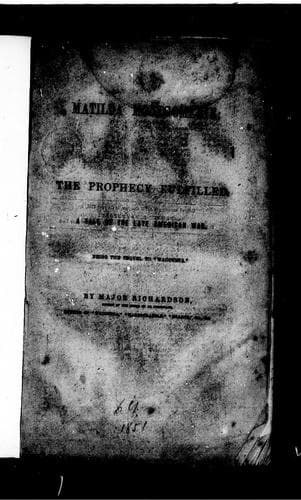
Matilda Montgomerie; Or, The Prophecy FulfilledRichardson, Major (John)
History
Matilda Montgomerie; Or, The Prophecy Fulfilled
Richardson, Major (John)
United States -- History -- War of 1812 -- Fiction
"More subtly perhaps you would say, Colonel; but seriously, I speak from
conviction alone. It is true, as a citizen of the United States, and
therefore one interested in the fair fame of its public acts, that
conviction may partake in some degree of partial influences; still it is
sincere. But to my argument. What I would maintain is, as I have before
stated, that in all we have done we have only followed the example of
England. For instance, when the colonisation of the Eastern and Southern
states of the Union took place, that is to say, when our common
ancestors first settled in this country, how was their object effected?
Why, by driving from their possessions near the sea, in order to make
room for themselves, those very nations whom we are accused of a desire
to exterminate, as if out of a mere spirit of wantonness. Did either
English or Dutch then hesitate as to what course _they_ should pursue,
or suffer any qualms of conscience to interfere with their colonial
plans? No; as a measure of policy--as a means of security--they sought
to conciliate the Indians, but not the less determined were they to
attain their end. Who, then, among Englishmen, would have thought of
blaming their fellow countrymen, when the object in view was the
aggrandizement of the national power, and the furtherance of individual
interests? While the colonists continued tributary to England they could
do no wrong--they incurred no censure. Each succeeding year saw them,
with a spirit that was _then_ deemed worthy of commendation, pushing
their advantages and extending their possessions, to the utter exclusion
and at the expense of the original possessors of the soil. For this they
incurred no blame. But mark the change: no sooner had the war of the
revolution terminated in our emancipation from the leading strings of
childhood--no sooner had we taken rank among the acknowledged nations of
the world--no sooner had we, in a word, started into existence as an
original people--than the course we had undeviatingly pursued in
infancy, and from which we did not dream of swerving in manhood, became
a subject for unqualified censure. What had been considered laudable
enterprise in the English colonist, became unpardonable ambition in the
American republican; and acts affecting the national prosperity, that
carried with them the approbation of society and good government during
our nonage, were stigmatized as odious and grasping the moment we had
attained our majority."
Public-domain text, read in full here on John Shaqi.
Reviews
Reviews
No reviews yet
Be the first to share your thoughts on this work.
Join the Discussion
Join the discussion
Sign in to leave a comment or review.
Sign InorCreate an account