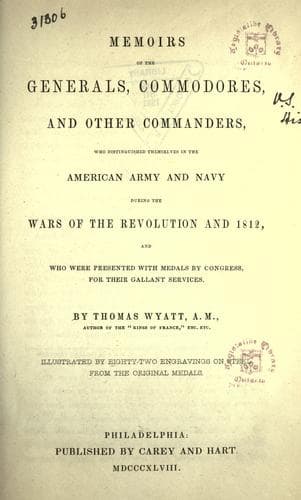
Memoirs of the Generals, Commodores and other Commanders, who distinguished themselves in the American army and navy during the wars of the Revolution and 1812, and who were presented with medals by Congress for their gallant services — John Shaqi
Memoirs of the Generals, Commodores and other Commanders, who distinguished themselves in the American army and navy during the wars of the Revolution and 1812, and who were presented with medals by Congress for their gallant servicesWyatt, Thomas
History
Memoirs of the Generals, Commodores and other Commanders, who distinguished themselves in the American army and navy during the wars of the Revolution and 1812, and who were presented with medals by Congress for their gallant services
Wyatt, Thomas
United States -- History -- Revolution, 1775-1783 -- Biography; United States -- History -- Revolution, 1775-1783 -- Medals; United States -- History -- War of 1812 -- Biography; United States -- History -- War of 1812 -- Medals
Next followed the brilliant victory of the Cowpens, in which Colonel
Washington contributed in no small degree. His ardor in this contest
had nearly cost him his life. Animating the troops to the pursuit
by his example, he advanced so far as to be surrounded by several
British officers. At the moment when the sword of one of them was
actually raised for his destruction, his brave bugleman fired a pistol
which disabled the British officer, and saved the life of his gallant
commander. Shortly after his cavalry was added to a body of horse
and foot selected by General Greene, and placed under the command of
Colonel Williams. Colonel Washington was happy to a degree in baffling
the efforts of Cornwallis to force Greene to a battle. He took a very
conspicuous part in the contest at Guildford Courthouse, where, by a
spirited and daring charge, he broke the British regiment of guards,
commanded by Colonel Stewart, who was killed; and with the brave
Colonel Howard and his gallant Marylanders, nearly effected their
entire destruction. Colonel Garden relates the following remarks made
to him by an officer of distinction in the army of the enemy:--“I
was near General Webster when the charge was made by Washington. The
desperate situation of the guards had its effect on all around. An
American officer quickly perceiving it, rode up to the British line and
called aloud, ‘Surrender, gentlemen, and be certain of good quarters.’
Terrified by appearances, and concluding that defeat was inevitable,
the soldiers of the regiment of De Bose were actually throwing down
their arms. In the midst of the confusion, General Webster, famed for
great presence of mind, exclaimed, ‘Unless that gallant fellow is taken
off, we are lost.’ A field-piece at this moment was brought up, and
directed to be fired into the throng where the guards now appeared
to be greatly outnumbered, and did so with the happiest success; the
cavalry wheeled off, the remains of the battalion rallied, and the army
was saved.”
At Hobkirk Hill, Colonel Washington added another wreath to his
well-earned laurels. Famous for skillful maneuvering, he cut off
the rear of the British line, capturing eleven officers and two
hundred men, but the early retreat of the American forces prevented
his bringing more than fifty of his prisoners off the field; these,
however, contained the eleven officers. At the battle of Eutaw, his
repeated charges on the British light infantry were signalized by
extraordinary bravery and valor. In an effort which required all his
courage, his horse was shot from under him, and becoming entangled
as he fell, he was taken prisoner. This was the closing scene of
his military performances, which had always been characterized by
ardor, bravery and decision; he knew danger only by name, and though
unfortunate at last, no officer in the American revolution ever in a
higher degree merited success.
Reviews
Reviews
No reviews yet
Be the first to share your thoughts on this work.
Join the Discussion
Join the discussion
Sign in to leave a comment or review.
Sign InorCreate an account