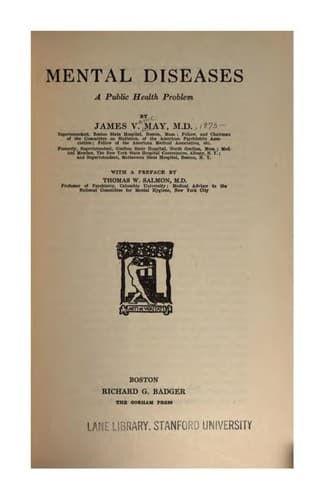
Mental diseases: a public health problem — John Shaqi
Mental diseases: a public health problemMay, James Vance
Science
Mental diseases: a public health problem
May, James Vance
Mental health services; Psychology, Pathological
Size and form of pupils. Residuals or formation of adhesion of iris.
Contraction of iris on exposure to strong light; on accommodation (for
near vision) and after shutting the eye.
Imperfect sight (reading print), improved or not by glasses, dimness
of sight, limitation of field of vision, scotoma, hemianopsia, loss of
color sense; anomalies of refraction. Condition of apparatus (cornea,
lens, vitreous body). Ophthalmoscopy where indicated (for choked disc,
optic atrophy, lesions of the fundus). Field of vision where indicated
and possible (reversal of color fields in hysteria; scotomata).
3. _Ears_:
Discharge, otoscopy. Defect of hearing on one or both sides (use watch
and tuning fork).
Conduction through skull. Tinnitus aurium (auscultation for actual
sound, over the head).
4. _Taste_:
Test separately the anterior two-thirds of tongue and the posterior
third with weak solution of sugar, quinine, acid, salt.
5. _Smell_:
Test each nostril with oil of cloves, bergamot, peppermint, wintergreen
and lemon. Note the actual answers.
Parosmia. Put down the actual extent of discrimination and recognition,
with explanation of defect (mental, local, or nervous).
6. _Cutaneous Sensibility_:
1. Tactile sensibility (use the finger-tip, feather, or pin). Compare
both sides of face, arms, hands, fingers, breasts, inner and outer
aspects of thighs and legs. (Never omit the ulnar side and the area
outside and above the knee). Sole and dorsum of feet.
2. Localization of touch (time and space) and tickle.
3. Sensibility to pain (cautious pricks with a pin, localization in
time and space), with or without the attention of the patient.
4. Sensations of heat and cold (cold water and warm water in a glass
tube).
(a) Sense of position: See below.
(b) Stereognostic sense.
5. Subjective sensations (formication, feeling of needles and pins,
numbness).
6. Tenderness of nerve trunks and muscles on pressure and percussion.
The distribution to be noted on the drawings of the body surface.
7. Biernacki's sign (analgesia of the ulnar nerve); anesthesia of
eyeball; of testicles.
7. _Vasomotor and Trophic Conditions_:
Salivation, seborrhea.
Cyanosis or pallor; scaliness or loss of hair; change of nails.
Blushing, dermatographia. General or localized perspiration.
Temperature of paralyzed or anesthetic parts.
8. _Motor Functions_:
Mobility of facial muscles (laugh) (wrinkle the forehead and the nose;
move the ears; show the teeth and shut the eyes); tongue; palate.
Muscles of the neck, trunk and extremities; gait.
Public-domain text, read in full here on John Shaqi.
Reviews
Reviews
No reviews yet
Be the first to share your thoughts on this work.
Join the Discussion
Join the discussion
Sign in to leave a comment or review.
Sign InorCreate an account