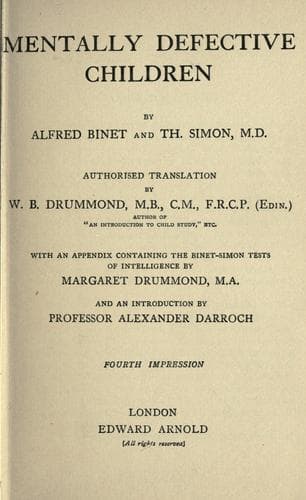
Children with mental disabilities -- Education; Children with mental disabilities -- Psychological testing
In spite of the lengthy details into which we enter, it is evident
that all this work of examination can be done pretty rapidly. The
arithmetic alone is a little long, because it is necessary to allow
time to put the child at his ease. We may put the total examination at
fifteen minutes. Often it will be possible to abridge the time. The
inspector is now in a position to estimate the retardation of the
pupil and his knowledge percentage. He has several means at his
disposal--the evidence of the teachers, the notes concerning the
pupil, the examination of his copybook, observation of the attitude of
the child, his physiognomy, etc., and, above all, the exact and
personal test which he has made.
Is this enough? When the inspector has established the retardation and
determined its causes, may he, should he, give his opinion
immediately? In most cases, without doubt, a further inquiry is not
necessary. But in other cases the need of further inquiry is felt.
Instruction is not everything, and there are some children who have
difficulty in assimilating school knowledge owing to want of aptitude,
to inattention, to laziness, who are yet quite intelligent. It is the
intelligence of these children that one would like to determine, and
for this it is necessary to make use of some tests of intelligence. We
propose, therefore, for the inspectors a last examination, a
psychological one. Let no one accuse us of complicating the
examinations. We do not impose them, we do not even advise them in
all cases. But these tests are none the less very valuable tools to
which one is very happy to have recourse when one feels embarrassed.
PSYCHOLOGICAL EXAMINATION.
This consists in putting the following questions,[10] which have been
grouped in such a manner that the four first can be answered by normal
children at seven years of age, the five following by normal children
at nine years of age, and the four last by normal children at eleven
years of age.
Tests of Intelligence.
_Seven Years._
1. If you were late for school, what would you do?
2. If you lost a train, what would you do?
3. If one is lazy and does not want to work, what happens?
4. If you were tired and had not enough money to take an
omnibus, what would you do?
_Nine Years._
5. If one needed sixpence, how could one get it?
6. Why should we not spend all our money, but put a little past?
7. If you break an object that does not belong to you, what
should you do?
8. If a companion should strike you without meaning it, what
should you do?
9. If you require some good advice, what should you do?
_Eleven Years._
10. Before taking part in anything important, what should you
do?
11. Why do we forgive a bad deed done in anger more readily than
a bad deed done without anger?
12. If anyone asks your opinion about a person whom you know
very little, what would you do?
Public-domain text, read in full here on John Shaqi.
Reviews
Reviews
No reviews yet
Be the first to share your thoughts on this work.
Join the Discussion
Join the discussion
Sign in to leave a comment or review.
Sign InorCreate an account