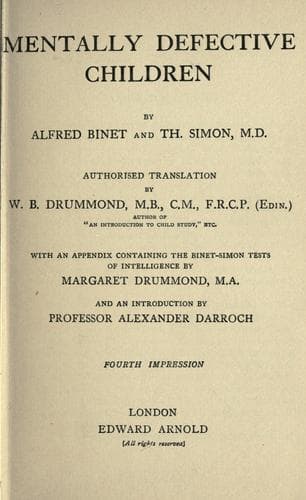
Children with mental disabilities -- Education; Children with mental disabilities -- Psychological testing
In the "intermediate course, second year," there were two children who
obtained 0 and 1. In the "intermediate course, first year," there were
four who got 0, and one who got only 1. What were these pupils, who
had certainly not reached the average intellectual level of eleven
years? Two are said to be defectives by the head-master. Let us
subtract them, and there remain five; and these work sufficiently well
to remain in their class and to follow the lessons. Their success is a
very important fact. A child may not have very much intelligence, but
if he has a good memory, application, and will, he is regular in his
studies, and this compensates for the mental feebleness. We have often
noticed this. If a child is regular in his school work, the question
whether he is a defective does not present itself. It only presents
itself if the case is reversed. Supposing he is very clearly backward,
by two years, by three years, with a sufficient school attendance. If,
in spite of this retardation, the psychological examination shows that
he is all the same quite intelligent, this is a favourable
circumstance of which he should have the advantage. In other terms,
the psychological examination is capable of showing that he is normal,
even when he is behindhand in his studies. This examination cannot, in
any case, serve to make him be regarded as defective if he is regular
in his studies. This is why we place this examination last.
Here are some very good replies from normal children:
_G. R----_:
10. It would be necessary to consider where the affair would
lead us.
11. Because when a bad action is done without anger one knows
what one is doing, while when one is angry one does not know
what one is doing.
12. One should say nothing. If one does not know the person one
cannot tell what he is.
13. By his words he may deceive us. By his acts we can tell what
he is.
_G----_:
10. It is necessary to think what one is going to do.
11. Because when one acts without anger one has thought
beforehand, and is more to blame; while, on the other hand, it
is an act of passion, and afterwards one regrets what one has
done.
12. I would say that it would be necessary to know him first and
then afterwards to judge him, not to say anything bad or good
about him without knowing him.
13. Because there are people who say words and often do not do
them.
Here are some replies which are mediocre or absurd:
12. You should try to ask the particulars of the person you do
not know. (Mediocre.)
13. Because his acts are more terrible while his words are less
threatening. (Mediocre.)
11. Because the action which has been done in anger is not so
violent. (Mediocre.)
13. Because you must not speak after the person who speaks.
(Absurd.)
Public-domain text, read in full here on John Shaqi.
Reviews
Reviews
No reviews yet
Be the first to share your thoughts on this work.
Join the Discussion
Join the discussion
Sign in to leave a comment or review.
Sign InorCreate an account