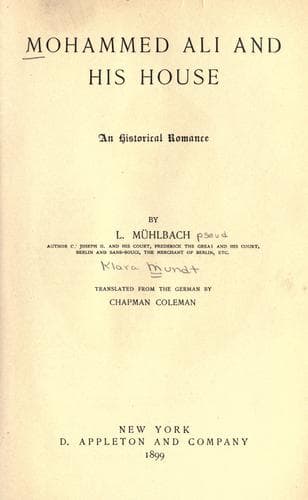
Egypt -- History -- Mohammed Ali, 1805-1849 -- Fiction; Muhammad Ali Basha, Governor of Egypt, 1769-1849 -- Fiction
Little boats dance about the ship, and all is activity and bustle.
In the interior of the land shines El-gahera, the new city, with the
palaces of the caliphs and its hundreds of minarets and temples. The
streets are alive with men of all nations; there are Turks and
Arabians, Egyptians and Europeans. The blacks of Nubia and Abyssinia
mingle with the white men of France and Germany, and the languages
of all nations are heard.
He lay on the rock, on the Ear of Bucephalus, gazing out into the
distance toward the horizon, imagining he could see these wondrous
cities. He dreamed of the glories of the world, and his fancy beheld
boats and ships, palaces and minarets.
The sea lies beneath like a blue mirror. The waves murmur in low
tones as they caress the shore. The stillness is profound, the
solitude of the first day of creation surrounds him. Suddenly a cry
resounds, a loud, piercing one, such as the eagle utters when his
young are in danger. It aroused Mohammed from his meditation.
"Strange! I heard the cry, yet I can nowhere see the eagle that
uttered it."
For the second time it resounds, louder and more piercing than
before. Mohammed shudders in his whole being.
The cry is not that of an eagle. It is a human voice. Toussoun has
uttered it, and it announces that his mother is in danger. He
springs with horror to his feet, and bounds from rock to rock, down
the steep-he has just heard the cry for the third time.
"Await me, mother! O my mother, I am coming!"
Like an arrow he speeds through the suburb to his mother's hut. Pale
and terrified, Toussoun meets him at the door. He had risen from his
bed of sickness in response to Khadra's call. With weak, trembling
lips he had entreated her to allow him to call her son, and he did
call him, breathing out his last remnant of strength in summoning
Mohammed to his mother. Pale, weak, and ill, he now returns to his
own hut, supported on the arm of a neighbor, and returns to die.
Mohammed has not noticed him. He springs to the door, tears it open,
and sees the women who have come to Sitta Khadra's assistance. Now
that he has come they walk out noiselessly, and wait at the door.
How long will it be before she is dead, before they can assume the
role of mourning-women, and begin their lamentations? True, Sitta
Khadra is poor, but then the community will, out of self-respect,
pay the mourning charges. Consoling themselves with this thought,
the women crouch down at the door.
Mohammed kneels beside the mat on which his mother lies, takes her
hands--now almost cold-in his own, bends over her and looks into the
widely-distended eyes that stare vacantly up at him, and sobs in
loud, heart-rending tones "Mother, Mother, Do you hear me? Here I
am, your son, Mohammed. You cannot die, for I am with you!"
Public-domain text, read in full here on John Shaqi.
Reviews
Reviews
No reviews yet
Be the first to share your thoughts on this work.
Join the Discussion
Join the discussion
Sign in to leave a comment or review.
Sign InorCreate an account