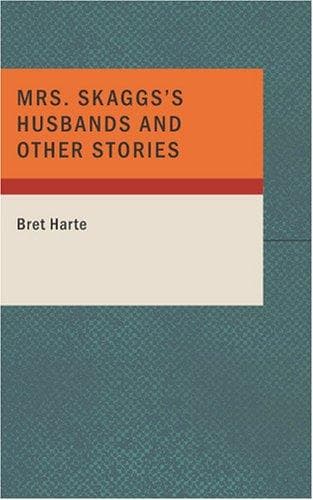
Mrs. Skagg's Husbands and Other StoriesHarte, Bret
General
Mrs. Skagg's Husbands and Other Stories
Harte, Bret
American fiction -- 19th century; Short stories; Western stories
We all knew that Mr. Thompson was looking for his son, and a pretty bad
one at that. That he was coming to California for this sole object was
no secret to his fellow-passengers; and the physical peculiarities, as
well as the moral weaknesses, of the missing prodigal were made equally
plain to us through the frank volubility of the parent. “You was
speaking of a young man which was hung at Red Dog for sluice-robbing,”
said Mr. Thompson to a steerage passenger, one day; “be you aware of
the color of his eyes?” “Black,” responded the passenger. “Ah,” said
Mr. Thompson, referring to some mental memoranda, “Char-les's eyes was
blue.” He then walked away. Perhaps it was from this unsympathetic mode
of inquiry, perhaps it was from that Western predilection to take a
humorous view of any principle or sentiment persistently brought before
them, that Mr. Thompson's quest was the subject of some satire among the
passengers. A gratuitous advertisement of the missing Charles, addressed
to “Jailers and Guardians,” circulated privately among them; everybody
remembered to have met Charles under distressing circumstances. Yet
it is but due to my countrymen to state that when it was known that
Thompson had embarked some wealth in this visionary project, but little
of this satire found its way to his ears, and nothing was uttered in
his hearing that might bring a pang to a father's heart, or imperil
a possible pecuniary advantage of the satirist. Indeed, Mr. Bracy
Tibbets's jocular proposition to form a joint-stock company to
“prospect” for the missing youth received at one time quite serious
entertainment.
Perhaps to superficial criticism Mr. Thompson's nature was not
picturesque nor lovable. His history, as imparted at dinner, one day, by
himself, was practical even in its singularity. After a hard and wilful
youth and maturity,--in which he had buried a broken-spirited wife, and
driven his son to sea,--he suddenly experienced religion. “I got it in
New Orleans in '59,” said Mr. Thompson, with the general suggestion
of referring to an epidemic. “Enter ye the narrer gate. Parse me the
beans.” Perhaps this practical quality upheld him in his apparently
hopeless search. He had no clew to the whereabouts of his runaway son;
indeed, scarcely a proof of his present existence. From his indifferent
recollection of the boy of twelve, he now expected to identify the man
of twenty-five.
Public-domain text, read in full here on John Shaqi.
Reviews
Reviews
No reviews yet
Be the first to share your thoughts on this work.
Join the Discussion
Join the discussion
Sign in to leave a comment or review.
Sign InorCreate an account