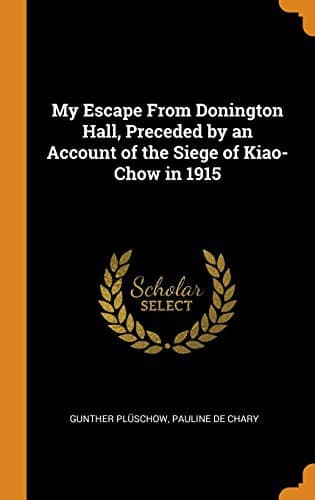
My Escape from Donington Hall, Preceded by an Account of the Siege of Kiao-Chow in 1915Plüschow, Gunther
History
My Escape from Donington Hall, Preceded by an Account of the Siege of Kiao-Chow in 1915
Plüschow, Gunther
Prisoner-of-war escapes; World War, 1914-1918 -- Personal narratives, German; World War, 1914-1918 -- Prisoners and prisons, British
The whole of Japan fêted to-day the defeat and humiliation of the
German Empire. I read that night in the Japanese papers, which appeared
in English, that Japan had achieved that which the English, French
and Russians had tried in vain—to defeat Germany; and that from now
onwards their army was the best and the strongest in the whole world.
But enough of this, the Americans and the English have not shown
greater restraint on other occasions.
Twice more the steamer ran into harbour during the next days. Both
at Kobe and Yokohama my cabin witnessed the same procedure as at
Nagasaki—Mr. MacGarvin remained ill and unmolested.
We stayed five days in all in Japan. At last, after I had kept to my
bunk for a whole week, we left those dangerous shores. And when they
disappeared on the horizon a young man on the steamer is said to have
danced with joy and frantically waved a small hat, which had belonged
to a little girl in far-away China, shouting laughingly: “Good-bye,
Japs! Good-bye, Japs!”
The days passed pleasantly enough amidst the recreations which are
usual on board an ocean-going steamer. I met several Germans, whom the
war had thrust forth from their adopted country; also a brother officer
who had been lately busy at Shanghai, and a war-comrade; the American
war correspondent, Mr. Brace, who was the only foreigner to take part
in the whole siege of Kiao-Chow.
Neptune took care to provide us with a change. Shortly before Honolulu,
we were caught in a typhoon, which lasted nearly two days and
threatened our ship with dire peril.
When we arrived in Honolulu the sun was shining brightly, and I had to
look twice before I dared trust my eyes. For did I not see the German
war flag!
And as we dropped anchor there lay alongside, like a tiny cockleshell,
the small cruiser _Geier_, which, coming from the South Seas, had run
the blockade and had just been interned. What a curious meeting! I met
dear comrades again from whom I had heard nothing for a long time, in
the midst of war, far from our country, after momentous happenings. We
talked and talked without end.
At the beginning of the war the _Geier_ lay far away to the south
amongst the coral-reefs. She only heard of the Russian mobilization,
then her wireless went to pieces, and she swam about without news in
the Pacific. Only fourteen days later, the _Geier_ heard something
of the war with England and later with Japan. This meant caution.
Surrounded and hunted by a score of enemies, the small cruiser achieved
a voyage of many thousands of sea miles to Honolulu, either taken
in tow by a small steamer or sailing on her own. And when the huge
Japanese cruiser, which lay on the watch for her at the mouth of the
harbour, one fine morning beheld the cockleshell safe in port, with the
German flag flying at the masthead, the yellow monkey had to slink off
homewards with its tail between its legs.
Public-domain text, read in full here on John Shaqi.
Reviews
Reviews
No reviews yet
Be the first to share your thoughts on this work.
Join the Discussion
Join the discussion
Sign in to leave a comment or review.
Sign InorCreate an account