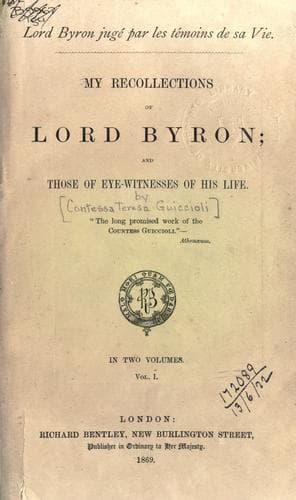
My Recollections of Lord ByronGuiccioli, Teresa, contessa di
General
My Recollections of Lord Byron
Guiccioli, Teresa, contessa di
Byron, George Gordon Byron, Baron, 1788-1824; Poets, English -- 19th century -- Biography
The Almighty has created beings of such harmonious and ideal beauty that
they defy description or analysis. Such a one was Lord Byron. His
wonderful beauty of expression has never been rendered either by the
brush of the painter or the sculptor's chisel. It summed up in one
magnificent type the highest expression of every possible kind of
beauty. If his genius and his great heart could have chosen a human form
by which they could have been well represented, they could not have
chosen another! Genius shone in his very looks. All the effects and
emotions of a great soul were therein reflected as well as those of an
eminently good and generous heart, and indeed contrasts were visible
which are scarcely ever united in one and the same person. His eyes
seized and betrayed the sentiments which animated him, with a rapidity
and transparency such as called forth from Sir Walter Scott the remark,
that the fine head of his young rival "was like unto a beautiful
alabaster vase lightened up by an interior lamp." To see him, was to
understand thoroughly how really false were the calumnies spread about
as to his character. The mass, by their obstinacy in identifying him
with the imaginary types of his poems, and in judging him by a few
eccentricities of early youth, as well as by various bold thoughts and
expressions, had represented to themselves a factitious Byron, totally
at variance with the real man. Calumnies, which unfortunately he passed
over in disdainful silence, have circulated as acknowledged facts. Time
has destroyed many, but it would not be correct to say that they have
all entirely been destroyed. Lord Byron was silent, because he depended
upon time to silence his calumniators. All those who saw him must have
experienced the charm which surrounded him as a kind of sympathetic
atmosphere, gaining all hearts to him. What can be said to those who
never saw him? Tell them to look at the pictures of him which were
painted by Saunders, by Phillips, by Holmes, or by Westall? All these,
although the works of great artists, are full of faults. Saunders's
picture represents him with thick lips, whereas his lips were
harmoniously perfect: Holmes almost gives him a large instead of his
well-proportioned and elegant head! In Phillips's picture the expression
is one of haughtiness and affected dignity, never once visible to those
who ever saw him.[7]
"These portraits," says Dallas, "will certainly present to the stranger
and to posterity that which it is possible for the brush to reproduce
so far as the features are concerned, but the charm of speech and the
grace of movement must be left to the imagination of those who have had
no opportunity to observe them. No brush can paint these."
The picture of Byron by Westall is superior to the others, but does not
come up to the original. As for the copies and engravings which have
been taken from these pictures, and circulated, they are all
exaggerated, and deserve the appellation of caricatures.
Public-domain text, read in full here on John Shaqi.
Reviews
Reviews
No reviews yet
Be the first to share your thoughts on this work.
Join the Discussion
Join the discussion
Sign in to leave a comment or review.
Sign InorCreate an account