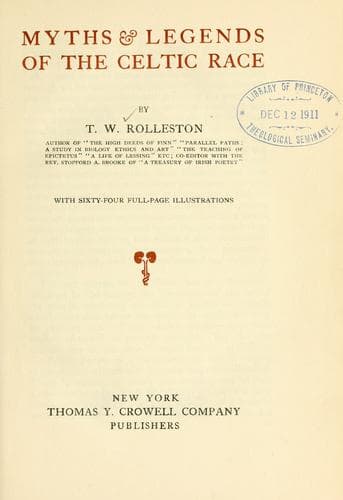
Myths & Legends of the Celtic RaceRolleston, T. W. (Thomas William)
Religion
Myths & Legends of the Celtic Race
Rolleston, T. W. (Thomas William)
Celts -- Religion; Mythology, Celtic
Of one thing I personally feel convinced—that the problem of the ethical,
social, and intellectual development of the people constituting what is
called the “Celtic Fringe” in Europe ought to be worked for on Celtic
lines; by the maintenance of the Celtic tradition, Celtic literature,
Celtic speech—the encouragement, in short, of all those Celtic affinities
of which this mixed race is now the sole conscious inheritor and guardian.
To these it will respond, by these it can be deeply moved; nor has the
harvest ever failed those who with courage and faith have driven their
plough into this rich field. On the other hand, if this work is to be done
with success it must be done in no pedantic, narrow, intolerant spirit;
there must be no clinging to the outward forms of the past simply because
the Celtic spirit once found utterance in them. Let it be remembered that
in the early Middle Ages Celts from Ireland were the most notable
explorers, the most notable pioneers of religion, science, and speculative
thought in Europe.(73) Modern investigators have traced their footprints
of light over half the heathen continent, and the schools of Ireland were
thronged with foreign pupils who could get learning nowhere else. The
Celtic spirit was then playing its true part in the world-drama, and a
greater it has never played. The legacy of these men should be cherished
indeed, but not as a museum curiosity; nothing could be more opposed to
their free, bold, adventurous spirit than to let that legacy petrify in
the hands of those who claim the heirship or their name and fame.
*The Mythical Literature*
After the sketch contained in this and the foregoing chapter of the early
history of the Celts, and of the forces which have moulded it, we shall
now turn to give an account of the mythical and legendary literature in
which their spirit most truly lives and shines. We shall not here concern
ourselves with any literature which is not Celtic. With all that other
peoples have made—as in the Arthurian legends—of myths and tales
originally Celtic, we have here nothing to do. No one can now tell how
much is Celtic in them and how much is not. And in matters of this kind it
is generally the final recasting that is of real importance and value.
Whatever we give, then, we give without addition or reshaping. Stories, of
course, have often to be summarised, but there shall be nothing in them
that did not come direct from the Celtic mind, and that does not exist
to-day in some variety, Gaelic or Cymric, of the Celtic tongue.
CHAPTER III: THE IRISH INVASION MYTHS
*The Celtic Cosmogony*
Public-domain text, read in full here on John Shaqi.
Reviews
Reviews
No reviews yet
Be the first to share your thoughts on this work.
Join the Discussion
Join the discussion
Sign in to leave a comment or review.
Sign InorCreate an account