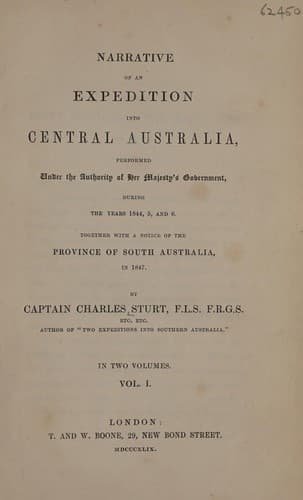
Narrative of an Expedition into Central Australia: Performed Under the Authority of Her Majesty's Government, During the Years 1844, 5, and 6, Together With A Notice of the Province of South Australia in 1847 — John Shaqi
Narrative of an Expedition into Central Australia: Performed Under the Authority of Her Majesty's Government, During the Years 1844, 5, and 6, Together With A Notice of the Province of South Australia in 1847Sturt, Charles
History
Narrative of an Expedition into Central Australia: Performed Under the Authority of Her Majesty's Government, During the Years 1844, 5, and 6, Together With A Notice of the Province of South Australia in 1847
Sturt, Charles
Central Australia -- Discovery and exploration; Natural history -- Australia -- Central Australia; South Australia -- Description and travel
It would, however, have gratified me exceedingly
to have crossed into the Tropic, to have decided my own hypothesis as to
the fine country I ventured to predict would be found to exist beyond it.
My reasons for supposing which I thought I had explained in my first
letter to the Secretary of State, but as it would appear from an
observation in Sir John Barrow's memorandum, that I had not done so, I
deem it right briefly to record them here.
I had observed on my first expedition to the Darling, in 1828, when in
about lat. 29 degrees 30 minutes S. that the migration of the different
kinds of birds which visit the country east of the Darling during the
summer, was invariably to the W. N. W. Cockatoos and parrots that whilst
staying in the colony were known to frequent elevated land, and to select
the richest and best watered valleys for their temporary location, passed
in flights of countless number to the above-mentioned point. I had also
observed, during my residence in South Australia, that several of the
same kind of birds annually visited it, and that they came directly from
the north. I had seen the PSYTACUS NOVAE HOLLANDIAE and the SHELL
PARROQUET following the line of the shore of St. Vincent Gulf like
flights of starlings in England, and although intervals of more than a
quarter of an hour elapsed between the passing of one flight and that of
another, they all came from the north and followed in the same direction.
Now, although I am quite ready to admit that the casual appearance of a
few strange birds should not influence the judgment, yet I think that a
reasonable inference may be drawn from the regular and systematie
migration of the feathered races. Now, if we were to draw a line from
Fort Bourke to the W. N. W., and from Mount Arden to the north, we should
find that they would meet a little to the northward of the Tropic, and as
I felt assured of two lines of migration thus tending to the same point,
there could be little doubt but that the feathered races migrating upon
them rested at that point, for a time, so I was led to conclude that the
country to which they went would in a great measure resemble that which
they had left--that birds which delighted in rich valleys, or kept on
lofty hills, surely would not go into deserts and into a flat country;
and therefore it was that I was led to hope, that as the fact of large
migrations from various parts of the continent to one particular part,
seemed to indicate the existence either of deserts or of water to a
certain distance, so the point at which migration might be presumed to
terminate would be found a richer country than any which intervened. On
the late expedition, I accidentally fell into the line of migration to
the north-west, and birds that I was aware visited Van Diemen's Land
passed us, after watering, to that point of the compass. Cockatoos would
frequently perch in our trees at night, and wing their way to the
Reviews
Reviews
No reviews yet
Be the first to share your thoughts on this work.
Join the Discussion
Join the discussion
Sign in to leave a comment or review.
Sign InorCreate an account