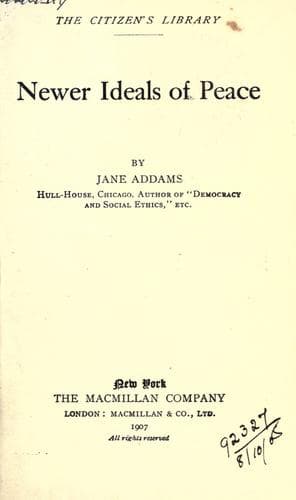
Municipal government -- United States; Peace; Political participation -- United States; Social justice; Working class -- United States
While governmental functions have shown this remarkable adaptation
and growth in relation to the youth, whether he be in the public
schools, in the Juvenile Court or in the reformatory, we hesitate
to assume toward the adult this temper of the educator who humbly
follows and at the same confidently leads the little child. While the
State spends millions of dollars and employs thousands of servants to
nurture and heal the sick and defective, it steadfastly refuses to
extend its kindliness to the normal working man. The Socialists alone
constantly appeal for this extension. They refuse, however, to deal
with the present State and constantly take refuge in the formulae of
a new scholasticism. Their orators are busily engaged in establishing
two substitutes for human nature which they call “proletarian” and
“capitalist.” They ignore the fact that varying, imperfect human nature
is incalculable, and that to eliminate its varied and constantly
changing elements is to face all the mistakes and miscalculations which
gathered around the “fallen man,” or the “economic man,” or any other
of the fixed norms which have from time to time been substituted for
expanding and developing human life. In time “the proletarian” and “the
capitalist” will become the impedimenta which it will be necessary to
clear away in order to make room for the mass of living and breathing
citizens with whom self-government must eventually deal.
There is no doubt that the existence of the mass, the mere size of the
modern city, increases the difficulty of the situation. Charles Booth’s
maps portraying the standard of living for the people of London afford
almost the only attempt at a general social survey of a modern city, at
least so far as it may be predetermined from the standard of income.
From his accompanying twelve volumes may be deduced the occupations of
the people with their real wages, their family budget and their culture
level, and, to a certain extent, their recreations and spiritual life.
If one gives one’s self over to a moment of musing on this mass of
information, so huge and so accurate, one is almost instinctively aware
that any radical changes, so much needed in the blackest districts,
must largely come from forces outside the life of the people. An
enlarged mental life must come from the educationalist, increased
wages from the business interests, alleviation of suffering from the
philanthropists. What vehicle of correction is provided for the people
themselves, what device has been invented for loosing that kindliness
and mutual aid which is the marvel of all charity visitors? What broad
basis has been laid down for a modification of their most genuine and
pressing needs through their own initiative? The traditional Government
expresses its activity in keeping the streets clean and the district
lighted and policed. It is only during the last quarter of a century
that the London County Council has erected decent houses, public
Public-domain text, read in full here on John Shaqi.
Reviews
Reviews
No reviews yet
Be the first to share your thoughts on this work.
Join the Discussion
Join the discussion
Sign in to leave a comment or review.
Sign InorCreate an account