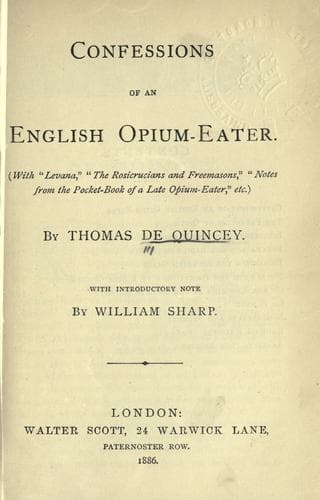
Note Book of an English Opium-EaterDe Quincey, Thomas
Philosophy
Note Book of an English Opium-Eater
De Quincey, Thomas
Opium abuse -- England
It would be a mistake to fancy that this tendency to confound real merit
and its accidents of position is at all peculiar to us or to our age. Dr.
Sacheverell, by embarking his small capital of talent on the springtide of
a furious political collision, brought back an ampler return for his
little investment than ever did Wickliffe or Luther. Such was his
popularity in the heart of love and the heart of hatred, that he would
have been assassinated by the Whigs, on his triumphal progresses through
England, had he not been canonized by the Tories. He was a dead man if he
had not been suddenly gilt and lacquered as an idol. Neither is the case
peculiar at all to England. Ronge, the _ci-devant_ Romish priest (whose
name pronounce as you would the English word _wrong_, supposing that it
had for a second syllable the final _a_ of 'sopha,' _i.e._, _Wronguh_),
has been found a wrong-headed man by _all_ parties, and in a venial degree
is, perhaps, a stupid man; but he moves about with more _eclat_ by far
than the ablest man in Germany. And, in days of old, the man that burned
down a miracle of beauty, viz., the temple of Ephesus, protesting, with
tears in his eyes, that he had no other way of getting himself a name,
_has_ got it in spite of us all. He's booked for a ride down all history,
whether you and I like it or not. Every pocket dictionary knows that
Erostratus was that scamp. So of Martin, the man that parboiled, or par-
roasted York Minster some ten or twelve years back; that fellow will float
down to posterity with the annals of the glorious cathedral: he will
'Pursue the triumph and partake the gale,'
whilst the founders and benefactors of the Minster are practically
forgotten.
These incendiaries, in short, are as well known as Ephesus or York; but
not one of us can tell, without humming and hawing, who it was that
rebuilt the Ephesian wonder of the world, or that repaired the time-
honored Minster. Equally in literature, not the weight of service done, or
the power exerted, is sometimes considered chiefly--either of these must
be very conspicuous before it will be considered at all--but the splendor,
or the notoriety, or the absurdity, or even the scandalousness of the
circumstances [1] surrounding the author.
Public-domain text, read in full here on John Shaqi.
Reviews
Reviews
No reviews yet
Be the first to share your thoughts on this work.
Join the Discussion
Join the discussion
Sign in to leave a comment or review.
Sign InorCreate an account