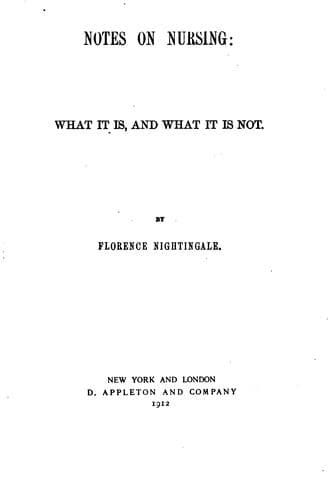
Notes on Nursing: What It Is, and What It Is NotNightingale, Florence
Science
Notes on Nursing: What It Is, and What It Is Not
Nightingale, Florence
Nursing
Want of cleanliness, then, in rooms _and_ wards, which you have to guard
against, may arise in three ways.
[Sidenote: Dirty air from without.]
1. Dirty air coming in from without, soiled by sewer emanations, the
evaporation from dirty streets, smoke, bits of unburnt fuel, bits of
straw, bits of horse dung.
[Sidenote: Best kind of wall for a house.]
If people would but cover the outside walls of their houses with plain
or encaustic tiles, what an incalculable improvement would there be in
light, cleanliness, dryness, warmth, and consequently economy. The play
of a fire-engine would then effectually wash the outside of a house.
This kind of _walling_ would stand next to paving in improving the
health of towns.
[Sidenote: Dirty air from within.]
2. Dirty air coming from within, from dust, which you often displace,
but never remove. And this recalls what ought to be a _sine qua non_.
Have as few ledges in your room or ward as possible. And under no
pretence have any ledge whatever out-of sight. Dust accumulates there,
and will never be wiped off. This is a certain way to soil the air.
Besides this, the animal exhalations from your inmates saturate your
furniture. And if you never clean your furniture properly, how can your
rooms or wards be anything but musty? Ventilate as you please, the rooms
will never be sweet. Besides this, there is a constant _degradation_, as
it is called, taking place from everything except polished or glazed
articles--_E.g._ in colouring certain green papers arsenic is used. Now
in the very dust even, which is lying about in rooms hung with this kind
of green paper, arsenic has been distinctly detected. You see your dust
is anything but harmless; yet you will let such dust lie about your
ledges for months, your rooms for ever.
Again, the fire fills the room with coal-dust.
[Sidenote: Dirty air from the carpet.]
3. Dirty air coming from the carpet. Above all, take care of the
carpets, that the animal dirt left there by the feet of visitors does
not stay there. Floors, unless the grain is filled up and polished, are
just as bad. The smell from the floor of a school-room or ward, when any
moisture brings out the organic matter by which it is saturated, might
alone be enough to warn us of the mischief that is going on.
[Sidenote: Remedies.]
The outer air, then, can only be kept clean by sanitary improvements,
and by consuming smoke. The expense in soap, which this single
improvement would save, is quite incalculable.
The inside air can only be kept clean by excessive care in the ways
mentioned above--to rid the walls, carpets, furniture, ledges, &c., of
the organic matter and dust--dust consisting greatly of this organic
matter--with which they become saturated, and which is what really makes
the room musty.
Without cleanliness, you cannot have all the effect of ventilation;
without ventilation, you can have no thorough cleanliness.
Public-domain text, read in full here on John Shaqi.
Reviews
Reviews
No reviews yet
Be the first to share your thoughts on this work.
Join the Discussion
Join the discussion
Sign in to leave a comment or review.
Sign InorCreate an account