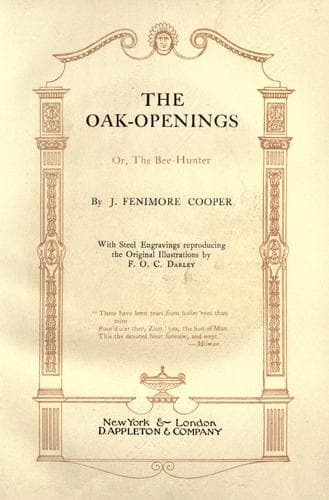
American fiction -- 19th century; Historical fiction; Indians of North America -- Fiction
in the young American of her sex, who is placed above the necessity of
labor.
As a stranger approached her, the countenance of this fair creature
expressed both surprise and satisfaction; surprise that any one should
have been met by Gershom, in such a wilderness, and satisfaction that
the stranger proved to be a white man, and seemingly one who did not
drink.
“You are Blossom,” said the bee-hunter, taking the hand of the
half-reluctant girl, in a way so respectful and friendly that she could
not refuse it, even while she doubted the propriety of thus receiving an
utter stranger--“the Blossom of whom Gershom Waring speaks so often, and
so affectionately?”
“You are, then, my brother's friend,” answered Margery, smiling so
sweetly, that le Bourdon gazed on her with delight. “We are SO glad
that he has come back! Five terrible nights have sister and I been here
alone, and we have believed every bush was a red man!”
“That danger is over, now, Blossom; but there is still an enemy near you
that must be overcome.”
“An enemy! There is no one here, but Dolly and myself. No one has been
near us, since Gershom went after the bee-hunter, whom we heard was out
in the openings. Are you that bee-bunter?”
“I am, beautiful Blossom; and I tell you there is an enemy here, in your
cabin, that must be looked to.”
“We fear no enemies but the red men, and we have seen none of them since
we reached this river. What is the name of the enemy you so dread, and
where is he to be found?”
“His name is Whiskey, and he is kept somewhere in this hut, in casks.
Show me the place, that I may destroy him, before his friend comes to
his assistance.”
A gleam of bright intelligence flashed into the face of the beautiful
young creature. First she reddened almost to scarlet; then her face
became pale as death. Compressing her lips intensely, she stood
irresolute--now gazing at the pleasing and seemingly well-disposed
stranger before her, now looking earnestly toward the still distant
forms of her brother and sister, which were slowly advancing in the
direction of the cabin.
“Dare you?” Margery at length asked, pointing toward her brother.
“I dare: he is now quite sober, and may be reasoned with. For the sake
of us all, let us profit by this advantage.”
“He keeps the liquor in two casks that you will find under the shed,
behind the hut.”
Public-domain text, read in full here on John Shaqi.
Reviews
Reviews
No reviews yet
Be the first to share your thoughts on this work.
Join the Discussion
Join the discussion
Sign in to leave a comment or review.
Sign InorCreate an account